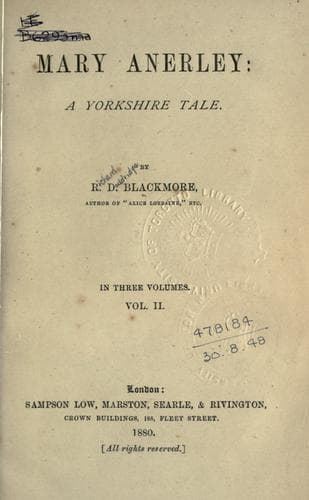
Mary Anerley: A Yorkshire TaleBlackmore, R. D. (Richard Doddridge)
General
Mary Anerley: A Yorkshire Tale
Blackmore, R. D. (Richard Doddridge)
Yorkshire (England) -- Fiction
“I follow the tactics with which you succeed--all above-board, and no
stratagems. Your own letter brought me; but perhaps I am too old to be
so impatient. Where shall I meet you, and on what day?”
“This day fortnight, at the Thornwick Inn, I shall hope to be with you
at three o'clock, and perhaps bring somebody with me. If I fixed an
earlier day, I should only disappoint you. For many things have to be
delicately managed; and among them, the running of a certain cargo,
without serious consequence. For that we may trust a certain very
skillful youth. For the rest you must trust to a clumsier person, your
humble land-agent and surveyor--titles inquired into and verified, at a
tenth of solicitors' charges.”
“Well,” said Sir Duncan, “you shall verify mine, as soon as you have
verified my son, and my title to him. Good-by, Mordacks. I am sure you
mean me well, but you seem to be very long about it.”
“Hot climates breed impatience, sir. A true son of Yorkshire is never in
a hurry. The general complaint of me is concerning my wild rapidity.”
“You are like the grocer, whose goods, if they have any fault at all,
have the opposite one to what the customer finds in them. Well, good-by,
Mordacks. You are a trusty friend, and I thank you.”
These words from Sir Duncan Yordas were not merely of commonplace.
For he was a man of great self-reliance, quick conclusion, and strong
resolve. These had served him well in India, and insured his fortune;
while early adversity and bitter losses had tempered the arrogance of
his race. After the loss of his wife and child, and the breach with all
his relatives, he had led a life of peril and hard labor, varied with
few pleasures. When first he learned from Edinburgh that the ship
conveying his only child to the care of the mother's relatives was lost,
with all on board, he did all in his power to make inquiries. But
the illness and death of his wife, to whom he was deeply attached,
overwhelmed him. For while with some people “one blow drives out
another,” with some the second serves only to drive home, deepen, and
aggravate the first. For years he was satisfied to believe both losses
irretrievable. And so he might still have gone on believing, except for
a queer little accident.
Being called to Calcutta upon government business, he happened to see a
pair of English sailors, lazily playing, in a shady place by the side of
the road, at hole-penny. One of them seemed to have his pocket cleared
out, for just as Sir Duncan was passing, he cried, “Here, Jack, you give
me change of one of them, and I'll have at you again, my boy. As good as
a guinea with these blessed niggers. Come back to their home, I b'lieve
they are, same as I wish I was; rale gold--ask this gen'leman.”
The other swore that they were “naught but brass, and not worth a copper
farden”; until the tars, being too tipsy for much fighting, referred the
question to Sir Duncan.
Public-domain text, read in full here on John Shaqi.
Reviews
Reviews
No reviews yet
Be the first to share your thoughts on this work.
Elsewhere in the archive
Join the Discussion
Join the discussion
Sign in to leave a comment or review.
Sign InorCreate an account