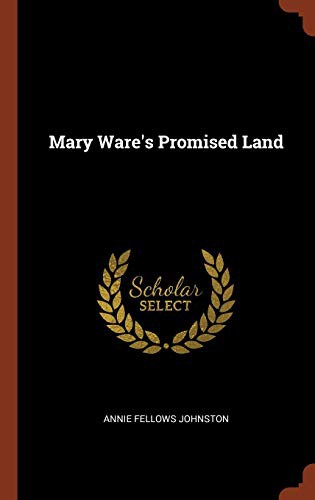
Mary Ware's Promised LandJohnston, Annie F. (Annie Fellows)
General
Mary Ware's Promised Land
Johnston, Annie F. (Annie Fellows)
Young women -- Juvenile fiction
"But I can't go on this way," she exclaimed, catching a glimpse of her
wan-eyed reflection in the mirror. "Such a half-hearted sort of giving
won't do any good. I shall have to do as the nuns do when they shut
their convent gate on the world, shut it entirely and forever. I shall
have to put away everything that reminds me of Phil."
She glanced around the room. How many reminders there were, for she had
always treasured everything he had ever sent her; books, pictures,
little curios picked up on his travels. Even an odd stone he had found
on the desert and brought into the Wigwam one day, she used now as a
paperweight. An Indian basket he had bought from an old squaw at
Hole-in-the-rock held her sewing materials. Just under her hand on the
table lay the little book he had given her to read on the train when she
was starting home after Jack's accident, "The Jester's Sword." As she
fingered it caressingly, it seemed to open of its own accord to the
fly-leaf, where was printed the line from Stevenson: "To renounce when
that shall be necessary and not be embittered." And then on the opposite
page--"Because he was born in Mars' month the bloodstone became his
signet, sure token that undaunted courage would be the jewel of his
soul."
She had thought those lines were wonderfully helpful when she offered
them to Jack as an inspiration to renew _his_ courage, but what a hollow
mockery they seemed now that the time had come to apply them to her own
case. Still, the thought of the brave Jester persisted, and was with her
when she went down to breakfast, and later when she went to the station
to meet Mrs. Blythe. She, too, would wear her sword of conquest so
hidden, and unbeknown, even to those who walked closest to her side.
Almost feverishly she threw herself into the duties of the next few
days, glad that an accumulation of letters on Mrs. Blythe's desk kept
her busy at the typewriter all morning, and that some investigating for
the Associated Charities kept her tramping about the streets the rest of
the time, until nightfall. She thought that she was hiding her secret so
successfully that no one imagined she had one. She talked more than
usual at the table, she laughed at the slightest excuse, she joined
spiritedly in the repartee at dinner, a time when they nearly always had
guests. But keen-eyed Mrs. Blythe saw several things in the course of
the week. She noticed her lack of appetite, the long spells of
abstraction that came sometimes after her merriest outbursts; the deep
shadows under her eyes of a morning, as if she had passed many sleepless
hours.
Public-domain text, read in full here on John Shaqi.
Reviews
Reviews
No reviews yet
Be the first to share your thoughts on this work.
Elsewhere in the archive
Join the Discussion
Join the discussion
Sign in to leave a comment or review.
Sign InorCreate an account