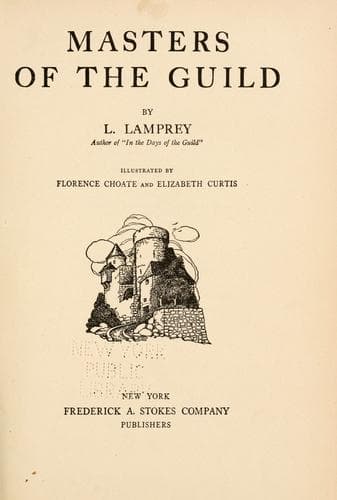
Great Britain -- History -- Medieval period, 1066-1485 -- Juvenile fiction; Guilds -- Juvenile fiction; Middle Ages -- Juvenile fiction
There was shouting and laughter in the courtyard. In came most of the
boys and young men of the place, bearing the great Yule log into the
hall. Collet the maid, who had just come in with her mistress, bearing
the Yule candle, was sent to get the charred remnant of last year's log.
Both log and candle would burn through the twelve holidays without being
quite consumed, and the bit that was left would be saved to light next
year's fires. These familiar homely ceremonies were not for the stately
untouched newness of the banquet-room.
Supper was but just over, and the roasted crab-apples were spluttering
in the bowls of brown ale, when the mummers came, capering in their
very best fashion and habited in antic robes whose pattern--if not the
costume itself--had come down from past generations. These actors were
village clowns who had seen such pageants in their boyhood, and they
played their rude drama as they had seen it then, with perhaps a new
song or two and a few speeches to tickle the ears of the new audience.
All the household and many of the villagers crowded in after them
to look and laugh and make remarks more or less humorous about the
performance. The lord of the castle and his family disposed themselves
to give their countenance to the merrymaking, and Sir Walter ordered
the steward to see that the players had a good supper. He himself would
distribute some money among them when the time came. Then they would go
on to give the play wherever else they could hope for an audience.
The drama was supposed to be founded on the life of Saint George, but
no one could say with truth that it was very much like the legend. First
came a herald tooting on a cow-horn, to proclaim the entrance of the
champion, who was Clement the carpenter mounted on a hobby-horse and
armed with wooden sword and painted buckler. There was much giggling and
whispering among the maids, directed at the demure black-eyed Madelon,
of the still-room. This may have been a reason why Saint George stumbled
so desperately over his rather long speech. His challenge was at last
finished, and then was heard a discordant clashing of tambourines and
horse-bells, supposed to indicate Saracen music. In cantered a turbaned
Turk on another hobby,--black this time--and in another long speech very
smoothly delivered defied the saint to mortal combat. There was more
tittering, for Tom the blacksmith was also an admirer of that minx
Madelon. The fight was a very lively one, and Saint George had some
trouble in holding his own.
Public-domain text, read in full here on John Shaqi.
Reviews
Reviews
No reviews yet
Be the first to share your thoughts on this work.
Elsewhere in the archive
Join the Discussion
Join the discussion
Sign in to leave a comment or review.
Sign InorCreate an account