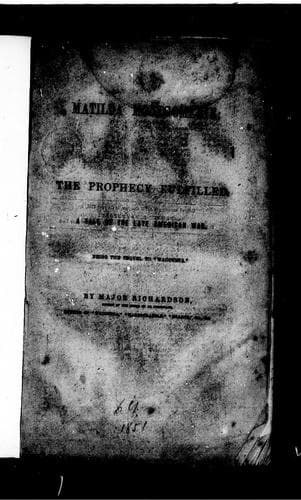
Matilda Montgomerie; Or, The Prophecy FulfilledRichardson, Major (John)
History
Matilda Montgomerie; Or, The Prophecy Fulfilled
Richardson, Major (John)
United States -- History -- War of 1812 -- Fiction
"Thank you, dearest," and the encircling arm of the impassioned officer
drew her form closer to his beating heart. "Gertrude, you are witness of
her vow, and before you, under more auspicious circumstances, will I
claim its fulfilment. Oh Julia, Julia, this indeed does recompense me
for many a long hour of anxiety and doubt."
"And hers too have been hours of anxiety and doubt," said the gentle
Gertrude. "Ever since the war has been spoken of as certain, Julia has
been no longer the gay girl she was. Her dejection has been subject of
remark with all, and such is her dislike to any allusion to the past,
that she never even rallies Captain Cranstoun on his bear-skin adventure
of last winter on the ice."
"Ah," interrupted the American, "never shall I forget the evening that
preceded that adventure. It was then, dearest Julia, that I ventured to
express the feeling with which you had inspired me. It was then I had
first the delight of hearing from your lips that I need not entirely
despair. I often, often, think of that night."
"Of course you have not yet received my note, Ernest. Perhaps you will
deem it inconsiderate in me to have written, but I could not resist the
desire to afford you what I conceived would be a gratification, by
communicating intelligence of ourselves."
"Note! what note! and by whom conveyed?"
"Have you not heard," inquired Gertrude, warming into animation, "that
the General has sent a flag this morning to Detroit, and, under its
protection, two prisoners captured by my cousin, who is the officer that
conducts them."
"And to that cousin you have confided the letter?" interrupted the
Colonel, somewhat eagerly.
"No, not my cousin," said Julia, "but to one I conceived better suited
to the trust. You must know that my father, with his usual hospitality,
insisted on Major Montgomerie and his niece, the parties in question,
taking up their abode with us during the short time they remained."
"And to Miss Montgomerie you gave your letter," hurriedly exclaimed the
Colonel, starting to his feet, and exhibiting a countenance of extreme
paleness.
"Good heaven, Ernest! what is the matter? Surely you do not think me
guilty of imprudence in this affair. I was anxious to write to you,--I
imagined you would be glad to hear from me, and thought that the niece
of one of your officers would be the most suitable medium of
communication. I therefore confessed to her my secret, and requested her
to take charge of the letter."
"Oh, Julia, you have been indeed imprudent. But what said she--how
looked she when you confided to her our secret?"
"She made no other remark than to ask how long our attachment had
existed, and her look and voice were calm, and her cheek underwent no
variation from the settled paleness observable there since her arrival."
"And in what manner did she receive her trust?" again eagerly demanded
the Colonel.
Public-domain text, read in full here on John Shaqi.
Reviews
Reviews
No reviews yet
Be the first to share your thoughts on this work.
Elsewhere in the archive
Join the Discussion
Join the discussion
Sign in to leave a comment or review.
Sign InorCreate an account