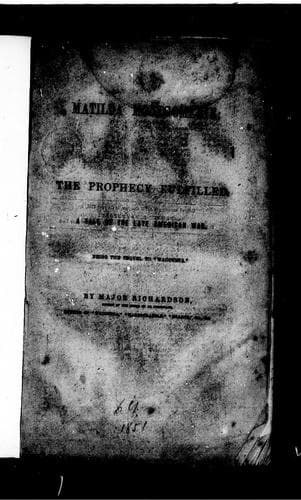
Matilda Montgomerie; Or, The Prophecy FulfilledRichardson, Major (John)
History
Matilda Montgomerie; Or, The Prophecy Fulfilled
Richardson, Major (John)
United States -- History -- War of 1812 -- Fiction
Late in that day, the barge of Gerald Grantham returned from Detroit.
Ushered into the presence of the General, the young sailor communicated
the delivery of his charge into the hands of the American Chief, who had
returned his personal acknowledgments for the courtesy. His answer to
the summons, however, was that having a force fully adequate to the
purpose, he was prepared to defend the fort to the last extremity, and
waiving his own original plan of attack, would await the British General
on the defensive, when to the God of Battles should be left the decision
of the contest. To a question on the subject, the young officer added
that he had seen nothing of the American flag of truce, either in going
or returning.
That night orders were issued to the heads of the different departments,
immediately to prepare _material_ for a short siege; and, an assault at
the termination of the third day.
CHAPTER XI.
Conformably with the orders of the British General, the siege of the
American fortress was commenced on the day following that of the mutual
exchange of flags. The elevated ground above the village of Sandwich,
immediately opposite to the enemy's fort, was chosen for the erection of
three batteries, from which a well sustained and well directed fire was
kept up for several successive days, yet without effecting any
practicable breach in their defences. One of these batteries, manned
principally by sailors, was under the direction of Gerald Grantham,
whose look-out on duty had been in a great degree rendered unnecessary,
by the advance of the English flotilla up the river, and who had
consequently been appointed to this more active service.
During the whole of Saturday, the 15th of August, the British guns had
continued to play upon the fort, vomiting shot and shell as from an
exhaustless and angry volcano--and several of the latter falling short,
the town which was of wood had been more than once set on fire. As,
however, it was by no means the intention of the General to do injury to
the inhabitants, no obstacle was opposed to the attempts of the enemy to
get it under, and the flames were as often and as speedily extinguished.
An advanced hour of night at length put an end to the firing, and the
artillery men and seamen, extended on their great-coats and pea-jackets,
in their several embrasures, snatched from fatigue the repose which
their unceasing exertions of the many previous hours had rendered at
once a luxury and a want.
The battery commanded by Gerald Grantham was the central and most
prominent of the three, and it had been remarked by all--and especially
by the troops stationed in the rear in support of the guns--that his
firing during the day had been the most efficient, many of his shots
going point blank into the hostile fortress, and (as could be distinctly
seen with the telescope) occasioning evident confusion.
Public-domain text, read in full here on John Shaqi.
Reviews
Reviews
No reviews yet
Be the first to share your thoughts on this work.
Elsewhere in the archive
Join the Discussion
Join the discussion
Sign in to leave a comment or review.
Sign InorCreate an account