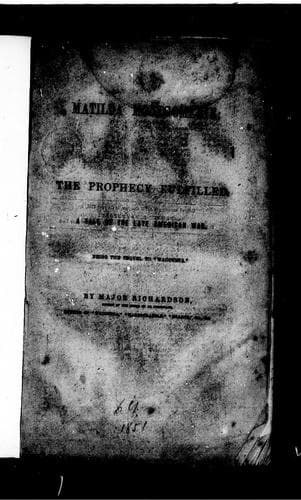
Matilda Montgomerie; Or, The Prophecy FulfilledRichardson, Major (John)
History
Matilda Montgomerie; Or, The Prophecy Fulfilled
Richardson, Major (John)
United States -- History -- War of 1812 -- Fiction
events, might have been suddenly placed on the Canadian bank, would have
been led to imagine that a fête, not a battle, was intended. Immediately
above the village of Sandwich, and in full view of the American Fort,
lay the English flotilla at anchor, their white sails half clewed up,
their masts decked with gay pendants, and their taffrails with ensigns
that lay drooping over their sterns in the water, as if too indolent to
bear up against the coming sultriness of the day. Below these,
glittering in bright scarlet that glowed not unpleasingly on the silvery
stream, the sun's rays dancing on their polished muskets and
accoutrements, glided, like gay actors in an approaching pageant, the
columns destined for the assault--while further down, and distributed
far and wide over the expanse of water, were to be seen a multitude of
canoes filled with Indian warriors, whose war costume could not, in the
distance, be distinguished from that of the dance--the whole
contributing, with the air of quietude on both shores, and absence of
all opposition on the American especially, to inspire feelings of
joyousness and pleasure, rather than the melancholy consequent on a
knowledge of the final destination of the whole. Nor would the incessant
thunder of the cannon in the distance, have in any way diminished this
impression; for as the volumes of smoke, vomited from the opposing
batteries, met and wreathed themselves together in the centre of the
stream, leaving at intervals the gay colors of England and America
brightly displayed to the view, the impression, to a spectator, would
have been that of one who witnesses the exchange of military honors
between two brave and friendly powers, preparing the one to confer, the
other to receive all the becoming courtesies of a chivalrous
hospitality. If anything were wanting to complete the illusion, the
sound of the early mass bell, summoning to the worship of that God whom
no pageantry of man may dispossess of homage, would amply crown and
heighten the effect of the whole, while the chanting of the hymn of
adoration would appear a part of the worship of the Deity, and of the
pageantry itself.
Public-domain text, read in full here on John Shaqi.
Reviews
Reviews
No reviews yet
Be the first to share your thoughts on this work.
Elsewhere in the archive
Join the Discussion
Join the discussion
Sign in to leave a comment or review.
Sign InorCreate an account