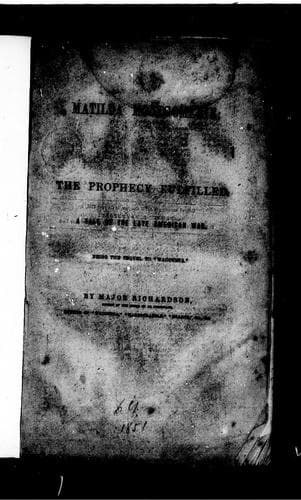
Matilda Montgomerie; Or, The Prophecy FulfilledRichardson, Major (John)
History
Matilda Montgomerie; Or, The Prophecy Fulfilled
Richardson, Major (John)
United States -- History -- War of 1812 -- Fiction
Meanwhile the sentinels at the several posts having been relieved, and
every thing ready for their departure, the American army, leaving their
arms piled in the area, commenced their evacuation of the Fort, the
artillery and troops of the line taking the lead. Watchfully alive to
the order that had been received, Captain Granville and Henry Grantham
lingered near the gate, regarding, yet with an air of carelessness,
every countenance among the irregular troops as they issued forth.
Hitherto their search had been ineffectual, and to their great surprise,
although the two last of the prisoners were now in the act of passing
them, there was not the slightest trace of Desborough. It was well known
that the fort had no other outlet, and any man attempting to escape over
the ramparts, must have been seen and taken either by the troops or by
the Indians, who in the far distance completely surrounded them. Captain
Granville intimated the possibility of Henry Grantham having been
deceived in the voice, but the latter as pertinaciously declared he
could not be mistaken, for, independently, of his former knowledge of
the man, his tones had so peculiarly struck him on the day when he made
boastful confession of his father's murder, that no time could efface
them from his memory. This short discussion terminated just as the last
few files were passing. Immediately in the rear of these were the
litters, on which were borne such of the wounded as could be removed
from the hospital without danger. These were some thirty in number, and
it seemed to both officers as somewhat singular, that the faces of all
were, in defiance of the heat of the day, covered with the sheets that
had been spread over each litter. For a moment the suspicion occurred to
Grantham, that Desborough might be of the number; but when he reflected
on the impossibility that any of the wounded men could be the same whose
voice had sounded so recently in the full vigor of health in his ear, he
abandoned the idea. Most of the wounded, as they passed, indicated by
low and feeble moaning, the inconvenience they experienced from the
motion to which they were subjected, and more or less expressed by the
contortions of their limbs, the extent of their sufferings. An exception
to this very natural conduct was remarked by Grantham, in the person of
one occupying nearly a central position in the line, who was carried
with difficulty by the litter-men. He lay perfectly at his length, and
without any exhibition whatever of that impatient movement which escaped
his companions. On the watchful eye of Grantham, this conduct was not
lost. He had felt a strong inclination from the first, to uncover the
faces of the wounded men in succession, and had only been restrained
from so doing by the presence of the American medical officer who
accompanied them, whom he feared to offend by an interference with his
charge. Struck as he was however by the remarkable conduct of the
Public-domain text, read in full here on John Shaqi.
Reviews
Reviews
No reviews yet
Be the first to share your thoughts on this work.
Elsewhere in the archive
Join the Discussion
Join the discussion
Sign in to leave a comment or review.
Sign InorCreate an account