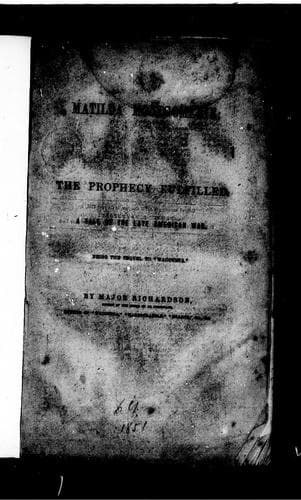
Matilda Montgomerie; Or, The Prophecy FulfilledRichardson, Major (John)
History
Matilda Montgomerie; Or, The Prophecy Fulfilled
Richardson, Major (John)
United States -- History -- War of 1812 -- Fiction
Perceiving the desperate situation of the respectable officer, Captain
Granville stayed not to question on a subject that spoke so plainly for
itself. Hastening back into the piazza with his subalterns, he reached
the area just as the remaining troops, intended for the occupation of
the fort, were crossing the drawbridge, headed by Colonel St. Julian. To
this officer he communicated the situation of the sufferer, when an
order was given for the instant attendance of the head of the medical
staff. After a careful examination and dressing of the wound, the latter
pronounced the case not altogether desperate. A great deal of blood had
been lost, and extreme weakness had been the consequence, but still the
Surgeon was not without hope that his life might yet be preserved,
although, of course, he would be a cripple for the remainder of his
days.
It might have been assumed, that the hope yet held out, of preservation
of life on any terms, would have been hailed with some manifestation of
grateful emotion, on the part of Miss Montgomerie; but it was remarked
and commented on, by those who were present, that this unexpectedly
favorable report, so far from being received with gratitude and delight,
seemed to cast a deeper gloom over the spirit of this extraordinary
girl. The contrast was inexplicable. She had tended him at the moment
when he was supposed to be dying, with all the anxious solicitude of a
fond child; and now that there was a prospect of his recovery, there was
a sadness in her manner that told too plainly the discomfort of her
heart.
"An unaccountable girl!" said Cranstoun, as he sipped his wine that day
after dinner, in the mess-room at Detroit. "I always said she was the
child of the devil."
"Child of the devil in soul, if you will," observed Granville, "but a
true woman--a beautiful, a superb woman in person at least, did she
appear this morning, when we first entered the room--did she not,
Henry?"
"Beautiful indeed," was the reply--"yet, I confess, she more awed than
pleased me. I could not avoid, even amid that melancholy scene,
comparing her to a beautiful casket, which, on opening, is found to
contain not a gem of price, but a subtle poison, contact with which is
fatal; or to a fair looking fruit, which, when divided, proves to be
rotten at the core."
"Allegorical, by all that is good, bad, and indifferent," exclaimed
Villiers. "How devilish severe you are, Henry, upon the pale Venus. It
is hardly fair in you thus to rate Gerald's intended."
"Gerald's intended! God forbid."
This was uttered with an energy that startled his companions. Perceiving
that the subject gave him pain, they discontinued allusion to the lady
in question, further than to inquire how she was to be disposed of, and
whether she was to remain in attendance on her uncle.
Public-domain text, read in full here on John Shaqi.
Reviews
Reviews
No reviews yet
Be the first to share your thoughts on this work.
Elsewhere in the archive
Join the Discussion
Join the discussion
Sign in to leave a comment or review.
Sign InorCreate an account