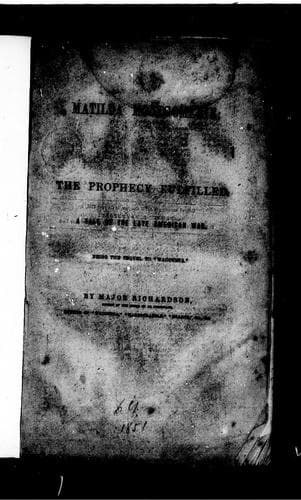
Matilda Montgomerie; Or, The Prophecy FulfilledRichardson, Major (John)
History
Matilda Montgomerie; Or, The Prophecy Fulfilled
Richardson, Major (John)
United States -- History -- War of 1812 -- Fiction
The cousins of Gerald Grantham had been in error in supposing him to be
the officer in command of the vessel on board which the lover of Julia
had embarked. His transfer from the gun-boat had taken place, but in
consideration of the fatigue he had undergone during the three
successive days in which he had been employed at the batteries, the
Commodore had directed another officer to take command of the vessel in
question, and charge himself with the custody of the prisoners on board.
Finding himself at liberty until the return of the flotilla from this
duty, the first care of Gerald was to establish himself in lodgings in
Detroit, whence he daily sallied forth to the apartments in the
Governor's house occupied by the unfortunate Major Montgomerie, in whose
situation he felt an interest so much the more deep and lively as he
knew his confinement to have been in some degree the work of his own
hands. All the attention and kindness could effect was experienced by
the respectable Major, who, in return, found himself more and more
attached to his youthful and generous captor. These constant visits to
the uncle naturally brought our hero more immediately into the society
of the niece, but although he had never been able to banish from his
memory the recollection of one look which she had bestowed upon him on a
former occasion, in almost every interview of the sort _now_, she
preserved the same cold distance and reserve which was peculiar to her.
A week had elapsed in this manner, when it chanced that as they both sat
one evening, about dusk, near the couch of the invalid, the latter,
after complaining of extreme weakness and unusual suffering, expressed
his anxiety at the possibility of his niece being left alone and
unprotected in a strange country.
It was with a beating pulse and a glowing cheek that Gerald looked up to
observe the effect of this observation on his companion. He was
surprised, nay, hurt, to remark that an expression of almost
contemptuous loathing sat upon her pale but beautiful countenance. He
closed his eyes for a moment in bitterness of disappointment--and when
they again opened and fell upon that countenance, he scarcely could
believe the evidence of his senses. Every feature had undergone a
change. With her face half turned, as if to avoid the observation of her
uncle, she now exhibited a cheek flushed with the expression of
passionate excitement, while from her eye beamed that same unfathomable
expression which had carried intoxication once before to the inmost soul
of the youth. Almost wild with his feelings, it was with difficulty he
restrained the impulse that would have urged him to her feet; but even
while he hesitated, her countenance had again undergone a change, and
she sat cold and reserved and colorless as before.
Public-domain text, read in full here on John Shaqi.
Reviews
Reviews
No reviews yet
Be the first to share your thoughts on this work.
Elsewhere in the archive
Join the Discussion
Join the discussion
Sign in to leave a comment or review.
Sign InorCreate an account