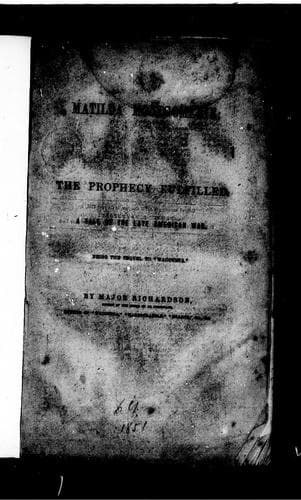
Matilda Montgomerie; Or, The Prophecy FulfilledRichardson, Major (John)
History
Matilda Montgomerie; Or, The Prophecy Fulfilled
Richardson, Major (John)
United States -- History -- War of 1812 -- Fiction
It was impossible, he conceived, that a door which stood only two paces
from the bed could be locked and unlocked without their hearing
it--neither was it probable that Desborough would have thought of thus
needlessly securing the place of his late detention. Such an idea might
occur to the aider, but not to the fugitive himself, to whom every
moment must be of the highest importance. Who then could have assisted
him? Not Major Montgomerie, for he slept in the after part of the
cabin--not Miss Montgomerie, for she was upon deck--moreover, had not
one of these, he had so much reason to suspect, interceded for the
fellow only on the preceding day.
Such was the reasoning of Gerald, as he passed rapidly in review the
several probabilities--but, although annoyed beyond measure at the
escape of the villain, and incapable of believing other than that the
daughters of the Governor had connived at it, his was too gallant by
nature to make such a charge, even by implication, against them.
Although extremely angry, he made no comment whatever on the subject,
but contenting himself with wishing his charge a less than usually
cordial good night, left them to their repose, and once more quitted the
cabin.
During the whole of this examination, Miss Montgomerie had continued on
deck. Gerald found her leaning over the gangway at which he had left
her, gazing intently on the water, through which the schooner was now
gliding at an increased rate. From the moment of his being compelled to
quit her side to inquire into the cause of Sambo's exclamation and
rapidly succeeding fall, he had not had an opportunity of again
approaching her. Feeling that some apology was due, he hastened to make
one; but, vexed and irritated as he was at the escape of the settler,
his disappointment imparted to his manner a degree of restraint, and
there was less of ardor in his address than he had latterly been in the
habit of exhibiting. Miss Montgomerie remarked it, and sighed.
"I have been reflecting," she said, "on the little dependence that is to
be placed upon the most flattering illusions of human existence--and
here are you come to afford me a painful and veritable illustration of
my theory."
"How, dearest Matilda! what mean you?" asked the officer, again warmed
into tenderness by the presence of the fascinating being.
"Can you ask, Gerald?" and her voice assumed a tone of melancholy
reproach--"recall but your manner--your language--your devotedness of
soul not an hour since--compare these with your present coolness, and
then wonder that I should have reason for regret."
"Now, Matilda, that coldness arose not from any change in my feelings
towards yourself--I was piqued, disappointed, even angry, at the
extraordinary escape of my prisoner, and could not sufficiently play the
hypocrite to disguise my annoyance."
"Yet, what had I to do with the man's escape that his offence should be
visited upon me?" she demanded quickly.
Public-domain text, read in full here on John Shaqi.
Reviews
Reviews
No reviews yet
Be the first to share your thoughts on this work.
Elsewhere in the archive
Join the Discussion
Join the discussion
Sign in to leave a comment or review.
Sign InorCreate an account