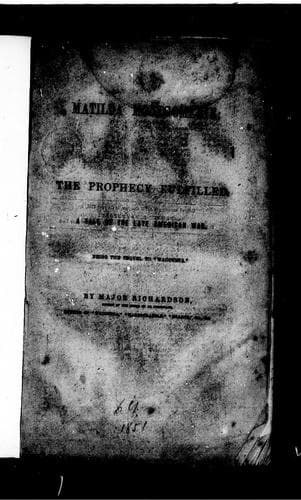
Matilda Montgomerie; Or, The Prophecy FulfilledRichardson, Major (John)
History
Matilda Montgomerie; Or, The Prophecy Fulfilled
Richardson, Major (John)
United States -- History -- War of 1812 -- Fiction
In ten minutes from the beating of the _reveillé_--considerably shorn of
its wonted proportions, as the occasion demanded--the bivouac had been
abandoned, and the little army again upon their march. What remained to
be traversed of the space that separated them from the enemy, was an
alternation of plain and open forest, but so completely in
juxtaposition, that the head of the column had time to clear one wood
and enter a second before its rear could disengage itself from the
first. The effect of this, by the dim and peculiar light reflected from
the snow across which they moved, was picturesque in the extreme, nor
was the interest diminished by the utter silence that had pervaded every
part of the little army, the measured tramp of whose march, mingled with
the hollow and unavoidable rumbling of the light guns, being the only
sounds to be heard amid that mass of living matter. The Indians, with
the exception of a party of scouts, had been the last to quit their rude
encampment, and as they now, in their eagerness to get to the front,
glided stealthily by in the deep snows on either side of the more beaten
track by which the troops advanced, and utterly without sound in their
foot-fall they might rather have been compared to spirits of the wilds,
than to human beings.
The regiment having been told off into divisions, it so happened that
Raymond and Henry Grantham, although belonging to different companies,
now found themselves near each other. The latter had been most anxious
to approach his really good-hearted companion, with a view to soothe his
wounded feelings, and to convey, in the fullest and most convincing
terms, the utter disclaimer of his inconsiderate brother officers, to
reflect seriously on his conduct in the recent retreat--or, indeed, to
intend their observations for anything beyond a mere pleasantry. As,
however, the strictest order had been commanded to be observed in the
march, and Raymond and he happened to be at opposite extremities of the
division, this had been for some time impracticable. A temporary halt
having occurred, just as the head of the column came within sight of the
enemy's fires, Grantham quitted his station on the flank, and hastened
to the head of his division, where he found Raymond with his arms folded
across his chest, and apparently absorbed in deep thought. He tapped him
lightly on the shoulder, and inquired in a tone of much kindness the
subject of his musing.
Touched by the manner in which he was addressed, Raymond dropped his
arms and grasping the hand of the youth, observed in his usual voice;
"Ah, is it you Henry--Egad, my dear boy, I was just thinking of you--and
how very kind you have always been; never quizzing me as those
thoughtless fellows have done--and certainly never insinuating anything
against my courage--that was too bad, Henry, too bad, I could have
forgiven anything but that."
Public-domain text, read in full here on John Shaqi.
Reviews
Reviews
No reviews yet
Be the first to share your thoughts on this work.
Elsewhere in the archive
Join the Discussion
Join the discussion
Sign in to leave a comment or review.
Sign InorCreate an account