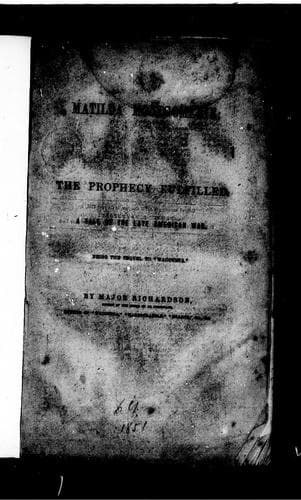
Matilda Montgomerie; Or, The Prophecy FulfilledRichardson, Major (John)
History
Matilda Montgomerie; Or, The Prophecy Fulfilled
Richardson, Major (John)
United States -- History -- War of 1812 -- Fiction
When the action was at the hottest, one of the small guns in front (all
of which had been fearfully exposed), was left without a single
artilleryman. Availing themselves of this circumstance, the enemy, who
were unprovided with artillery of any description, made a movement as if
to possess themselves of, and turn it against the attacking force, then
closing rapidly to dispute the possession of the breast work which
covered their riflemen. Colonel St. Julian seeing this movement, called
out for volunteers to rescue the gun from its perilous situation.
Scarcely had the words passed his lips when an individual moved forward
from the line, in the direction indicated. It was Lieutenant
Raymond--Exposed to the fire, both of friends and foes, the unfortunate
officer advanced calmly and unconcernedly, in the presence of the whole
line, and before the Americans could succeed in even crossing their
defences, had seized the gun by the drag rope, and withdrawn it under
cover of the English fire. But this gallant act of self-devotedness, was
not without its terrible price. Pierced by many balls, which the
American riflemen had immediately directed at him, he fell dying within
ten feet of the British line, brandishing his sword and faintly shouting
a "huzza," that was answered by his companions with the fierce spirit of
men stung to new exertion, and determined to avenge his fall.
Thus perished the fat, the plain, the carbuncled, but really
gallant-hearted Raymond--whose intrinsic worth was never estimated until
he had ceased to exist. His fall, and all connected therewith, forms a
sort of episode in our story, yet is it one not altogether without its
moral. A private monument, on which was inscribed all that may soothe
and flatter after death, was erected to his memory by those very
officers whose persiflage, attacking in this instance even his honor as
a soldier, had driven him to seek the fate he found. Of this there could
be no question; for, brave as he unquestionably was, Raymond would not
have acted as if courting death throughout, had he not fully made up his
mind either to gain great distinction or to die under the eyes of those
who had, he conceived, so greatly injured him. It is but justice to add
that, for three days from his death, Middlemore did not utter a single
pun, neither did St. Clair or Molineux indulge in a satirical
observation.
CHAPTER XX.
Public-domain text, read in full here on John Shaqi.
Reviews
Reviews
No reviews yet
Be the first to share your thoughts on this work.
Elsewhere in the archive
Join the Discussion
Join the discussion
Sign in to leave a comment or review.
Sign InorCreate an account