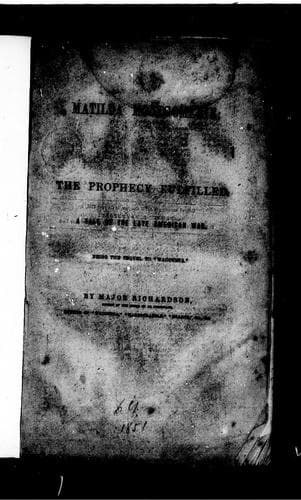
Matilda Montgomerie; Or, The Prophecy FulfilledRichardson, Major (John)
History
Matilda Montgomerie; Or, The Prophecy Fulfilled
Richardson, Major (John)
United States -- History -- War of 1812 -- Fiction
The day on which that Council was held, was characterized by one of
those sudden outbursts of elemental war, so common to the Canadas in
early summer, and which, in awful grandeur of desolation, are frequently
scarcely inferior to the hurricanes of the tropics. The morning had been
oppressively sultry, and there was that general and heavy lethargy of
nature that usually precedes a violent reaction. About noon a small,
dark speck was visible in the hitherto cloudless horizon, and this
presently grew in size until the whole western sky was one dense mass of
threatening black, which eventually spread itself over the entire
surface of the heavens leaving not a hand's breadth anywhere visible.
Presently, amid the sultry stillness that prevailed, there came a slight
breeze over the face of the waters, and then, as if some vast battering
train had suddenly opened its hundred mouths of terror, vomiting forth
showers of grape and other missiles, come astounding thunder-claps, and
forked lightnings, and rain, and hail, and whistling wind--all in such
terrible union, yet such fearful disorder, that man, the last to take
warning, or feel awed by the anger of the common parent, Nature, bent
his head in lowliness and silence to her voice, and awaited tremblingly
the passing away of her wrath.
Henry Grantham, whose turn of duty had again brought him to Amherstburg,
was in the mess-room of the garrison when the storm was at the fiercest.
Notwithstanding the excitement of the council-scene, at which he had
been present, he had experienced an unusual depression throughout the
day, originating partly in the languid state of the atmosphere, but
infinitely more in the anxiety under which he labored in regard to his
brother, of whom no other intelligence had been received, since his
departure with his prisoners for Buffalo, than what vague rumor, coupled
with the fact of the continued absence of the schooner, afforded. That
the vessel had been captured by the enemy there could be no doubt; but,
knowing as he did, the gallant spirit of Gerald, there was reason to
imagine that he had not yielded to his enemies, before every means of
resistance had been exhausted: and if so, what might not have been the
effect of his obstinacy, if such a term could be applied to unshaken
intrepidity, on men exasperated by opposition and eager for revenge. In
the outset he had admitted his gentle cousin Gertrude to his confidence,
as one most suited, by her docility, to soothe without appearing to
remark on his alarm, but when, little suspecting the true motive of her
agitation, he saw her evince an emotion surpassing his own, and
admitting and giving way to fears beyond any he would openly avow, he
grew impatient and disappointed, and preferring rather to hear the
tocsin of alarm sounded from his own heart than from the lips of
another, he suddenly, and much to the surprise of the affectionate girl,
discontinued all allusion to the subject. But Henry's anxiety was not
Public-domain text, read in full here on John Shaqi.
Reviews
Reviews
No reviews yet
Be the first to share your thoughts on this work.
Elsewhere in the archive
Join the Discussion
Join the discussion
Sign in to leave a comment or review.
Sign InorCreate an account