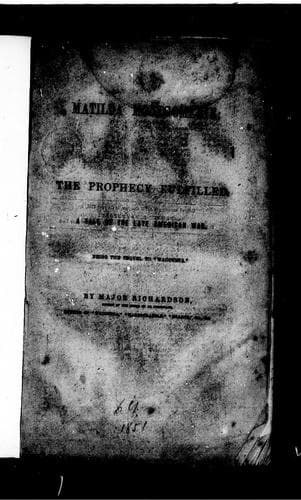
Matilda Montgomerie; Or, The Prophecy FulfilledRichardson, Major (John)
History
Matilda Montgomerie; Or, The Prophecy Fulfilled
Richardson, Major (John)
United States -- History -- War of 1812 -- Fiction
The painful nature of his reflections, added to the fatigue he had
undergone, had given to his countenance a more than usually haggard
expression. Henry remarked it and inquired the cause, when his brother,
in a few brief sentences, explained all that had occurred during his
absence. Full of affection as he was for the old man, and utterly
unprepared for such a communication, Henry could not avoid expressing
deep vexation that his brother, aware as he was of the peculiar weakness
of their aged friend, should have been inconsiderate enough to have
drawn him thither. Gerald felt the reproof to be just, and for that very
reason grew piqued under it. Pained as he was at the condition of Sambo,
Henry was even more distressed at witnessing the apparent apathy of his
brother for the fate of one who had not merely saved his life on a
recent occasion, but had evinced a devotedness--a love for him--in every
circumstance of life, which seldom had had their parallel in the annals
of human servitude. It was in vain that he endeavored to follow the
example of Gerald, who, having seated himself at the breakfast table,
was silently appeasing an appetite such as he had not exhibited since
his return. Incapable of swallowing his food, Henry paced up and down
the room, violently agitated and sick at heart. It seemed to him as if
Sambo had been a sort of connecting link between themselves and the
departed parents; and now that he was suddenly and fearfully afflicted,
he thought he could see in the vista of futurity a long train of evils
that threw their shadows before, and portended the consummation of some
unknown, unseen affliction, having its origin in the incomprehensible
alienation of his brother's heart from the things of his early love.
While he was yet indulging in these painful thoughts, the firing of a
gun from the harbor--the signal for the embarkation of the
troops--brought both Gerald and himself to a sense of other
considerations. The latter was the first to quit the house. "Henry," he
said, with much emotion, "God bless you. It is possible that, as our
service lies in different lines, we shall see but little of each other
during this expedition. Of one thing, however, be assured--that although
I am an unhappy man, I am anything but dead to feeling.--Henry," he
continued pressing his hand with warmth, "think not unkindly hereafter
of your poor brother Gerald." A long embrace, in which each, although in
silence, seemed to blend heart with heart, ensued, and both greatly
relieved, as they always were after this generous expansion of their
feelings, separated forthwith whither their respective duties summoned
them.
CHAPTER XXIII.
Public-domain text, read in full here on John Shaqi.
Reviews
Reviews
No reviews yet
Be the first to share your thoughts on this work.
Elsewhere in the archive
Join the Discussion
Join the discussion
Sign in to leave a comment or review.
Sign InorCreate an account