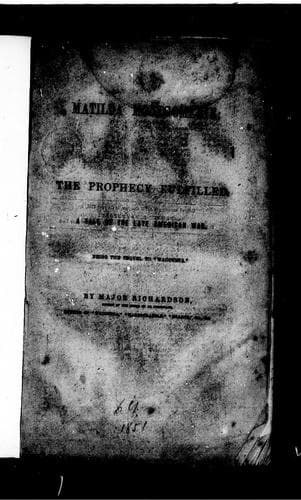
Matilda Montgomerie; Or, The Prophecy FulfilledRichardson, Major (John)
History
Matilda Montgomerie; Or, The Prophecy Fulfilled
Richardson, Major (John)
United States -- History -- War of 1812 -- Fiction
The English batteries had been constructed on the skirt of the wood
surrounding the fort, from which latter they were separated by a meadow
covered with long grass, about six hundred yards across at the narrowest
point. Behind these the columns of attack, three in number, were now
rapidly and silently formed. To that commanded by Captain Cranstoun, on
the extreme left, and intended to assault the fort at the strongest
point, Gerald Grantham had attached himself, in the simple dress, as we
have observed, of a private soldier, and armed with a common musket. In
passing, with the former officer, to take his position in front of the
column, he was struck by the utter want of means for executing with
success the duty assigned to the several divisions. Each column was
provided with a certain number of axemen, selected to act as pioneers;
but not one of the necessary implements was in a condition to be used:
neither had a single fascine or ladder been provided, although it was
well known that a deep ditch remained to be passed before the axes,
inefficient as they were, could be brought into use.
"Such," said Captain Cranstoun, with a sneer of much bitterness, "are
the pitiful things on which hang the lives of our brave fellows. No
doubt the despatches will say a great deal about the excellent
arrangements for attack--but if you do not fall, Gerald, I hope you will
make a proper representation of the affair. As you belong to the other
service, there is little fear the General can hurt your promotion for
merely speaking the truth. A General, indeed!--who'll say Fortune is not
blind to make a General of such as he?"
It was not an usual thing for Cranstoun to express himself thus in
regard to his superiors; but he was really vexed at the idea of the
sacrifice of human life that must attend this wantonness of neglect and
imbecility of arrangement. He had moreover taken wine enough, not in any
way to intoxicate, but sufficient to thaw his habitual caution and
reserve. Fearless as his sword, he cared not for his own life; but,
although a strict officer, he was ever attentive to the interests of his
men, who in their turn, admired him for his cool, unflinching courage,
and would have dared anything under the direction of their captain.
It was evident that the contempt of the sailor for the capacity of the
leader, to whom it was well known all the minute arrangements were
submitted, was not one whit inferior to what was entertained by the
brave and honest Cranstoun. He, however, merely answered, as they both
assumed their places in front, and with the air of one utterly
indifferent to these disadvantages.
"No matter, Cranstoun, the greater the obstacles we have to contend
against, the more glorious will be our victory. Where you lead, however,
we shall not be long in following."
Public-domain text, read in full here on John Shaqi.
Reviews
Reviews
No reviews yet
Be the first to share your thoughts on this work.
Elsewhere in the archive
Join the Discussion
Join the discussion
Sign in to leave a comment or review.
Sign InorCreate an account