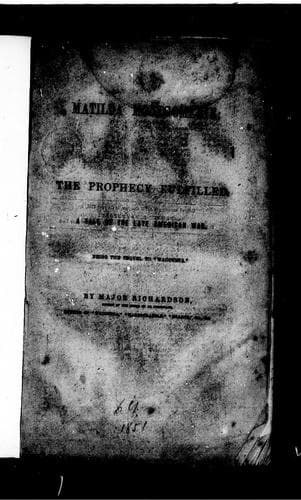
Matilda Montgomerie; Or, The Prophecy FulfilledRichardson, Major (John)
History
Matilda Montgomerie; Or, The Prophecy Fulfilled
Richardson, Major (John)
United States -- History -- War of 1812 -- Fiction
Accurate intelligence having been obtained from a party of scouts, who
had been dispatched early in the morning to track their course, that the
British General with his troops and Indians had finally departed,
preparations were made about midday for the interment of the fallen. Two
large graves were accordingly dug on the outer brow of the ravine, and
in these the bodies of the fallen soldiers were deposited, with all the
honors of war. A smaller grave, within the fort, and near the spot where
they so nobly fell, was considerately allotted to Cranstoun and
Middlemore. There was a composedness on the brow of the former that
likened him, even in death, to the living man; while, about the
good-humored mouth of poor Middlemore, played the same sort of
self-satisfied smile that had always been observable there when about to
deliver himself of a sally. Gerald, who had imposed upon himself the
painful duty of attending to their last committal to earth, could not
help fancying that Middlemore must have breathed his last with an
inaudible pun upon his lips--an idea that inexpressibly affected him.
Weighed down with sorrow as was his own soul, he had yet a tear for the
occasion--not that his brave comrades were dead, but that they had died
with so much to attach them to life--while he whose hope was in death
alone, had been chained, as by a curse to an existence compared with
which death was the first of human blessings.
On the following morning, after an early breakfast, he and Captain
Jackson quitted the fort, Colonel Forrester--who had not failed to
remark that the brusque manner of his aide-de-camp was not altogether
understood by his charge--taking occasion at parting, to assure the
latter that, with all his eccentricity, he was a kind-hearted man, whom
he had selected to be near him more for his personal courage, zeal, and
general liberality of feeling, than for any qualifications of intellect
he possessed.
Public-domain text, read in full here on John Shaqi.
Reviews
Reviews
No reviews yet
Be the first to share your thoughts on this work.
Elsewhere in the archive
Join the Discussion
Join the discussion
Sign in to leave a comment or review.
Sign InorCreate an account