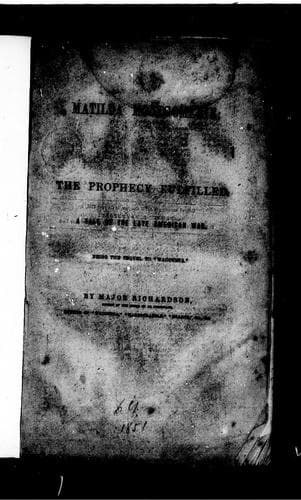
Matilda Montgomerie; Or, The Prophecy FulfilledRichardson, Major (John)
History
Matilda Montgomerie; Or, The Prophecy Fulfilled
Richardson, Major (John)
United States -- History -- War of 1812 -- Fiction
"Approved of man, if you will; but that they have the sanction of
heaven, I deny. Worldly policy and social interests alone have drawn the
distinction, making the one a crime, the other a virtue; but tell me not
that an all-wise and just God sanctions and approves the slaying of his
creatures, because they perish, not singly at the will of one man, but
in thousands and tens of thousands at the will of another. What is there
more sacred in the brawls of kings and potentates, that the blood they
cause to be shed in torrents for some paltry breach of etiquette, should
sit more lightly on their souls than the few solitary drops, spilt by
the hand of revenge, on that of him whose existence is writhing under a
sense of acutest injury?"
The energy with which she expressed herself, communicated a
corresponding excitement to her whole manner and person. Her eye
sparkled and dilated, and the visible heaving of her bosom told how
strongly her own feelings entered into the principles which she had
advocated. Never did her personal beauty shine forth more triumphantly
or seducingly than at the moment when her lips were giving utterance to
sentiments from which the heart recoiled.
"Oh Matilda," sighed Gerald, "with what subtlety of argument do you seek
to familiarize my soul with crime. But the attempt is vain. Although my
hand is pledged to do your will, my heart must ever mourn its guilt."
"Foolish Gerald," said Matilda; "why should that seem guilt to you, a
man, which to me, a woman, is but justice; but that unlike me you have
never entered into the calm consideration of the subject. Yes," she
pursued with greater energy, "what you call subtlety of argument is but
force of conviction. For two long years have I dwelt upon the deed,
reasoning, and comparing, until at length each latent prejudice has been
expelled, and to avenge my harrowing wrongs appeared a duty as
distinctly marked as any one contained in the decalogue. You saw me
once, Gerald, when my hand shrank not from what you term the assassin's
blow, and had you not interfered then, the deed would not now remain to
be accomplished."
"Oh, why did I interfere? why did my evil genius conduct me to such a
scene. Then had I lived at least in ignorance of the fearful act."
Public-domain text, read in full here on John Shaqi.
Reviews
Reviews
No reviews yet
Be the first to share your thoughts on this work.
Elsewhere in the archive
Join the Discussion
Join the discussion
Sign in to leave a comment or review.
Sign InorCreate an account