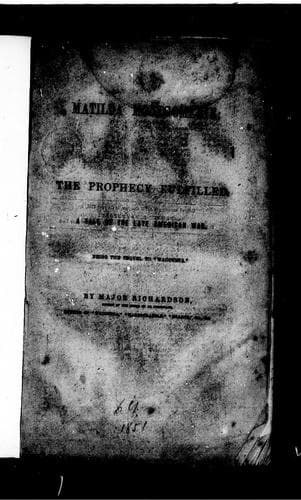
Matilda Montgomerie; Or, The Prophecy FulfilledRichardson, Major (John)
History
Matilda Montgomerie; Or, The Prophecy Fulfilled
Richardson, Major (John)
United States -- History -- War of 1812 -- Fiction
After the defeat of the British columns at Sandusky, so far from any
renewed attempts being made to interrupt the enemy in his strongholds,
it became a question whether the position on the Michigan frontier could
be much longer preserved. To the perseverance and promptitude of the
Americans, in bringing new armies into the field, we have already had
occasion to allude; but there was another quarter in which their
strength had insensibly gathered, until it eventually assumed an aspect
that carried apprehension to every heart. Since the loss of their
flotilla at Detroit, in the preceding year, the Americans had commenced
with vigour to equip one at Buffalo, which was intended to surpass the
naval force on Lake Erie; and so silently and cautiously had they
accomplished this task, that it was scarcely known at Amherstburg that a
squadron was in the course of preparation, when that squadron, to which
had been added the schooner captured from Gerald Grantham the preceding
autumn, suddenly appeared off the harbor, defying their enemies to the
combat. But the English vessels were in no condition to cope with so
powerful an enemy, and although many a gallant spirit burned to be led
against those who so evidently taunted them, the safety of the garrisons
depended too much on the issue, for that issue to be lightly tempted.
But misfortune was now beginning to overcast the hitherto fair prospects
of the British arms in the Western District of the Canadas; and what the
taunts of an enemy, triumphing in the consciousness of a superior
numerical force, could not effect, an imperative and miserably
provided-for necessity eventually compelled. Maintaining as they did a
large body of wild and reckless warriors, together with their families,
it may be naturally supposed the excesses of these people were not few;
but it would have required one to have seen, to have believed, the
prodigal waste of which they were often guilty. Acknowledging no other
law than their own will, following no other line of conduct than that
suggested by their own caprice, they had as little respect for the
Canadian inhabitant as they would have entertained for that of the
American enemy. And hence it resulted, that if an Indian preferred a
piece of fresh, to the salted meat daily issued from the commissariat,
nothing was more common than for him to kill the first head of cattle he
found grazing on the skirt of the forest, secure the small portion he
wanted, and leave the remainder to serve as carrion to the birds of prey
of the country. Nay, to such an extent was this wanton spoliation
carried, that instances have repeatedly occurred wherein cattle have
been slain and left to putrify in the sun, merely because a warrior
found it the most convenient mode by which to possess himself of a
powder-horn. All this was done openly--in the broad face of day, and in
the full cognisance of the authorities; yet was there no provision made
Public-domain text, read in full here on John Shaqi.
Reviews
Reviews
No reviews yet
Be the first to share your thoughts on this work.
Elsewhere in the archive
Join the Discussion
Join the discussion
Sign in to leave a comment or review.
Sign InorCreate an account