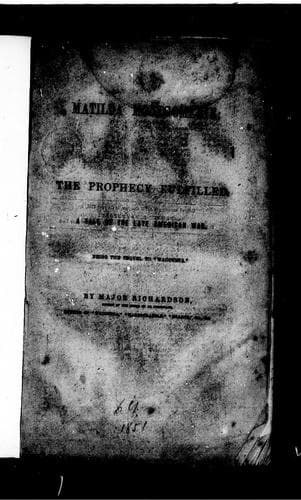
Matilda Montgomerie; Or, The Prophecy FulfilledRichardson, Major (John)
History
Matilda Montgomerie; Or, The Prophecy Fulfilled
Richardson, Major (John)
United States -- History -- War of 1812 -- Fiction
The result of the unlucky contest was, as had been anticipated, to open
a free passage across the lake to the American armies, whose advance by
land had been so repeatedly and effectually checked on former occasions,
as to leave them little inclination for a renewal of an attempt in that
quarter. Now however that they could forward a fleet of boats under
cover of the guns of their squadron, to the very outworks of
Amherstburg, the difficulty was at once removed; and an overwhelming
army of not less than ten thousand men, was speedily assembled near
Sandusky, with a view to the final invasion of Amherstburg and
consequent recapture of Detroit.
Under these disheartening circumstances--the want of provisions being
daily more and more felt by the troops and inhabitants--it became
necessary to hold a council of war, to determine upon the course that
should be pursued. Accordingly the whole of the chiefs and officers of
the garrison met in the hall already described in the beginning of our
narrative, when it was proposed by General Proctor, at the conclusion of
a speech in which the increasing difficulties and privations of the
garrison were emphatically enumerated, that the fortifications should be
razed to the ground, the dock yards and other public works destroyed,
and the allied forces of English and Indians make the best of their way
by land to join the centre division of the army on the Niagara frontier.
This was warmly opposed by Tecumseh, but despite his eloquence and
remonstrance, a few days later, and the work of destruction was entered
upon and soon completed. The little British army, scarcely exceeding
eight hundred men of all arms, commenced its march at night, lighted by
the flames of the barracks which had given them shelter for the last
time. As they passed the fort of Detroit the next day, dense columns of
smoke and flame were to be seen rising high in air, from the various
public edifices, affording a melancholy evidence of the destruction
which usually tracks a retreating army. Many an American inhabitant
looked on at the work of destruction, as if he would fain have arrested
the progress of an element which at once defaced the beauty of the town,
and promised much trouble and inconvenience to those whom they knew to
be at hand, for their final deliverance from the British yoke. But the
garrison continued stern spectators of the ruin they had been compelled
to effect, until the flames had attained a power which rendered then
suppression an impossibility; then and then only, did they quit the
scene of conflagration, and embarking in the boats which had been kept
in readiness for their transport, joined their comrades, who waited for
them on the opposite bank. The two garrisons thus united; the whole
preceded by a large body of Indians, were pushed forward to the position
which had been selected on the Thames, and both shores of the Detroit
were left an unresisting conquest to the Americans.
Public-domain text, read in full here on John Shaqi.
Reviews
Reviews
No reviews yet
Be the first to share your thoughts on this work.
Elsewhere in the archive
Join the Discussion
Join the discussion
Sign in to leave a comment or review.
Sign InorCreate an account