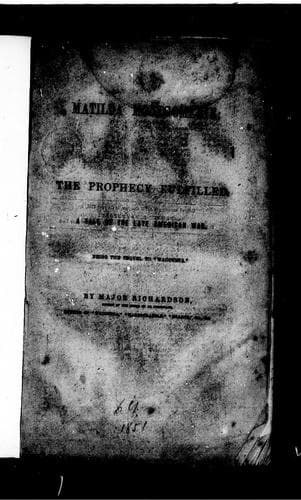
Matilda Montgomerie; Or, The Prophecy FulfilledRichardson, Major (John)
History
Matilda Montgomerie; Or, The Prophecy Fulfilled
Richardson, Major (John)
United States -- History -- War of 1812 -- Fiction
"The Colonel says--not suspected," again exclaimed Gerald with
increasing astonishment--then, suddenly recollecting the situation of
the latter--"tell me," he continued, "is Colonel Forrester in danger--is
his life despaired of?"
"Worth a dozen dead men yet, or you would'nt see me taking the thing so
coolly. The dagger certainly let the daylight into him, but though the
wound was pretty considerably deep, the doctors say its not mortal. He
thinks it might have been worse if you had not come up, and partly
stopped her arm when she struck at him."
Gerald was deeply affected by what he had just heard. It was evident
that Colonel Forrester had, with a generosity to which no gratitude of
his own could render adequate justice, sought to exonerate him from all
suspicion of participation in the guilty design upon his life, and as he
glanced his eye again for a moment upon the lifeless form of his
companion, he was at once sensible that the only being who could defeat
the benevolent object of his benefactor had now no longer the power to
do so.
"She sleeps sound enough now," said Jackson, again pointing to the
ill-fated and motionless girl, "but she'll sleep sounder yet before
long, I take it."
"She will never sleep sounder than at this moment, Captain Jackson,"
said Gerald, with solemn emphasis.
"Why, you don't mean to say she has cheated the hangman, Liftenant."
As he spoke, Jackson approached the sofa, and turning the light full
upon the face, saw indeed that she was dead. Gerald shuddered as the
rays from the lamp revealed for the first time the appalling change
which had been wrought upon that once beautiful countenance. The open
and finely formed brow was deeply knit, and the features distorted by
the acute agony which had wrung the shriek from her heart at the very
moment of dissolution, were set in a stern expression of despair. The
parted lips were drawn up at the corners in a manner to convey the idea
of the severest internal pain, and there was already a general
discoloration about the mouth, betraying the subtle influences of the
poison which had effected her death.
Gerald after the first glance, turned away his head in horror from the
view, but the Aide-de-camp remained for some moments calmly regarding
the remains of all that had once been most beautiful in nature.
"She certainly is not like what she was when Colonel Forrester first
knew her," he said, in the abstracted tone of one talking without
reference to any other auditor than himself; "but this comes of
preferring a nigger to a white man. Such unnatural courses never can
prosper, I take it."
"Captain Jackson," said Gerald, aroused by his remark, and with great
emphasis of tone, while he laid his hand impressively on the shoulder of
the other, "you do her wrong. Guilty as she has been, fearfully guilty,
but not in the sense you would imply."
"How do you know this?" asked the Aide-de-camp.
Public-domain text, read in full here on John Shaqi.
Reviews
Reviews
No reviews yet
Be the first to share your thoughts on this work.
Elsewhere in the archive
Join the Discussion
Join the discussion
Sign in to leave a comment or review.
Sign InorCreate an account