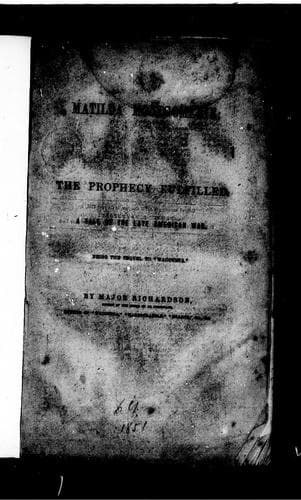
Matilda Montgomerie; Or, The Prophecy FulfilledRichardson, Major (John)
History
Matilda Montgomerie; Or, The Prophecy Fulfilled
Richardson, Major (John)
United States -- History -- War of 1812 -- Fiction
Deeply affected by this new proof of the favor of the generous American,
Gerald received the purse, saying, as he confided them to the breast of
his hunting frock--
"Captain Jackson, tell Colonel Forrester from me, that I accept his
present merely because in doing so I give the best evidences of my
appreciation of _all_ he has done for me on this trying occasion. In his
own heart, however, he must look for the only reward to which this most
noble of actions justly entitles him."
The frank-hearted Aide-de-camp promised compliance with this parting
message, and after pointing out the route it would be necessary to
follow, warmly pressed the hand of his charge in a final grasp, that
told how little he deemed the man before him capable of the foul
intention with which his soul had been so recently sullied.
How often during those hours of mad infatuation, when his weakened mind
had been balancing between the possession of Matilda at the price of
crime, and his abandonment of her at that of happiness, had the
observation of the Aide-de-camp, on a former occasion, that he "was
never born to be an assassin," occurred to his mind, suffusing his cheek
with shame and his soul with remorse. Now, too, that conscious of having
fallen in all but the positive commission of the deed, he saw that the
unsuspecting American regarded him merely as one whom accident or
intrigue had made an unwilling witness of the deadly act of a desperate
woman, his feelings were those of profound abasement and self-contempt.
There was a moment, when urged by an involuntary impulse, he would have
undeceived Captain Jackson as to his positive share in the transaction;
but pride suddenly interposed and saved him from the degradation of the
confession. He returned the pressure of the American's hand with
emphasis, and then turning his horse in the direction which he had been
recommended to take, quitted Frankfort for ever.
CHAPTER XXXI.
In October of the same year, a numerous body of Americans, principally
troops of the line, had been collected under the orders of General Van
Rensselaer, and advantage was taken of an extremely dark night to push
them across the river, with a view to the occupation of the commanding
heights above the village of Queenston. In this, favored by
circumstances, the enemy were eminently successful. They carried the
batteries, and at day-break the heights were to be seen covered with
their battalions, before whom were thrown out a considerable body of
riflemen. At the first alarm, the little detachment stationed at
Queenston marched out to dislodge them; but such was the impatient
gallantry of General Brock, who had succeeded to the command on this
line of frontier, that without waiting for the main body from Fort
George to come up, he threw himself at the head of the flank companies
of the Forty-Ninth, and moving forward in double quick time, soon came
within sight of the enemy.
Public-domain text, read in full here on John Shaqi.
Reviews
Reviews
No reviews yet
Be the first to share your thoughts on this work.
Elsewhere in the archive
Join the Discussion
Join the discussion
Sign in to leave a comment or review.
Sign InorCreate an account