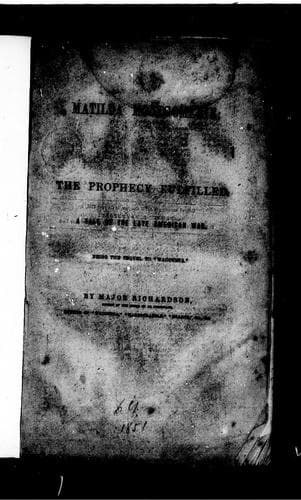
Matilda Montgomerie; Or, The Prophecy FulfilledRichardson, Major (John)
History
Matilda Montgomerie; Or, The Prophecy Fulfilled
Richardson, Major (John)
United States -- History -- War of 1812 -- Fiction
"After all," said the General, "necessary as it is to discourage it by
every possible mark of disapprobation, I do not see, in the mere act of
scalping, half the horrors usually attached to the practice. The motive
must be considered. It is not the mere desire to inflict wanton torture
that influences the warrior but an anxiety to possess himself of that
which gives undisputed evidence of his courage and success in war. The
prejudice of Europeans is strong against the custom, however, and we
look upon it in a light very different, I am sure from that in which it
is viewed by the Indians themselves. The burnings of prisoners, which
were practised many years ago, no longer continue; and the infliction of
the torture has passed away, so that, after all, Indian cruelty does not
exceed that which is practised even at this day in Europe, and by a
nation bearing high rank among the Catholic powers of Europe. I have
numerous letters, recently received from officers of my acquaintance now
serving in Spain, all of which agree in stating that the mutilations
perpetrated by the Guerilla bands, on the bodies of such of the
unfortunate French detachments as they succeeded in overpowering, far
exceeded anything imputed to the Indians of America; and, as several of
these letters are from individuals who joined the Peninsular Army from
this country, in which they had passed many years, the statement may be
relied on as coming from men who have had more than hearsay knowledge of
both parties."
Here a tall, fine-looking black, wearing the livery of Colonel
D'Egville, entering to announce that coffee was waiting for them in an
adjoining room--the party rose and retired to the ladies.
CHAPTER VII.
Many of our readers will doubtless bear in mind the spot called
Elliott's Point, at the western extremity of Lake Erie, to which we have
already introduced them. At a considerable distance beyond that again
(its intermediate shores washed by the silver waves of the Erie)
stretches a second, called also, from the name of its proprietor,
Hartley's Point. Between these two necks are three or four farms; one of
which, and adjoining Hartley's, was, at the period of which we treat,
occupied by an individual of whom, unfortunately for the interests of
Canada, too many of the species had been suffered to take root within
her soil.
Public-domain text, read in full here on John Shaqi.
Reviews
Reviews
No reviews yet
Be the first to share your thoughts on this work.
Elsewhere in the archive
Join the Discussion
Join the discussion
Sign in to leave a comment or review.
Sign InorCreate an account