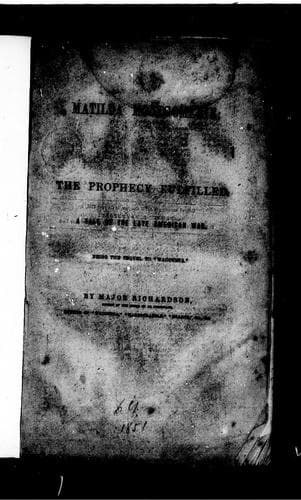
Matilda Montgomerie; Or, The Prophecy FulfilledRichardson, Major (John)
History
Matilda Montgomerie; Or, The Prophecy Fulfilled
Richardson, Major (John)
United States -- History -- War of 1812 -- Fiction
This person had his residence near Hartley's Point. Unlike those however
whose dwellings rose at a distance, few and far between, hemmed in by
the fruits of prosperous agriculture, he appeared to have paid but
little attention to the cultivation of a soil, which in every part was
of exceeding fertility. A rude log hut, situated in a clearing of the
forest, the imperfect work of lazy labor, was his only habitation, and
here he had for years resided without its being known how he contrived
to procure the necessary means of subsistence; yet, in defiance of the
apparent absence of all resources, it was subject of general remark,
that he not only never wanted money, but had been enabled to bestow
something like an education on a son, who had, at the epoch opened by
our narrative, been absent from him upwards of five years. From his
frequent voyages, and the direction his canoe was seen to take, it was
inferred by his immediate neighbors, that he dealt in contraband,
procuring various articles on the American coast, which he subsequently
disposed of in the small town of Amherstburg (one of the principal
English posts) among certain subjects domiciliated there, who were
suspected of no very scrupulous desire to benefit the revenue of the
country. So well and so wisely however, did he cover his operations,
that he had always contrived to elude detection--and, although suspicion
attached to his conduct, in no instance had he openly committed himself.
The man himself, tall, stout, and of a forbidding look, was of a
fearless and resolute character, and if he resorted to cunning, it was
because cunning alone could serve his purposes in a country, the laws of
which were not openly to be defied.
For a series of years after his arrival, he had contrived to evade
taking the customary oaths of allegiance; but this, eventually awakening
the suspicions of the magistracy, brought him more immediately under
their surveillance, when year after year, he was compelled to a renewal
of the oath, for the imposition of which, it was thought, he owed more
than one of those magistrates a grudge. On the breaking out of the war,
he still remained in undisturbed possession of his rude dwelling,
watched as well as circumstances would permit, it is true, but not so
narrowly as to be traced in his various nocturnal excursions by water.
Nothing could be conceived more uncouth in manner and appearance than
this man--nothing more villanous than the expression of his eye. No one
knew from what particular point of the United States he had come, and
whether Yankee or Kentuckian, it would have puzzled one of that race of
beings, so proverbial fer acumen--a Philadelphia lawyer--to have
determined.
Public-domain text, read in full here on John Shaqi.
Reviews
Reviews
No reviews yet
Be the first to share your thoughts on this work.
Elsewhere in the archive
Join the Discussion
Join the discussion
Sign in to leave a comment or review.
Sign InorCreate an account