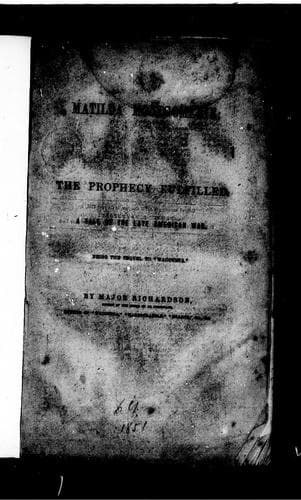
Matilda Montgomerie; Or, The Prophecy FulfilledRichardson, Major (John)
History
Matilda Montgomerie; Or, The Prophecy Fulfilled
Richardson, Major (John)
United States -- History -- War of 1812 -- Fiction
however, a character meriting rather more than the casual notice we have
bestowed, we shall take the opportunity, while he is hastening to the
discomfited officers on the beach, more particularly to describe him.
CHAPTER VIII.
Nearly midway between Elliott's and Hartley's points, both of which are
remarkable for the low and sandy nature of the soil, the land, raising
gradually towards the centre, assumes a more healthy and arable aspect;
and, on its highest elevation, stood a snug, well cultivated property,
called Girty's farm. From this height, crowned on its extreme summit by
a neat and commodious farm-house, the far reaching sands, forming the
points above-named, are distinctly visible. Immediately in the rear, and
commencing beyond the orchard which surrounded the house, stretched
forestward, and to a considerable distance, a tract of rich and
cultivated soil, separated into strips by zig-zag enclosures, and
offering to the eye of the traveller, in appropriate season, the several
species of American produce, such as Indian corn, buck wheat, &c., with
here and there a few patches of indifferent tobacco. Thus far of the
property, a more minute description of which is unimportant. The
proprietors of this neat little place were a father and son, to the
latter of whom was consigned, for reasons which will appear presently,
the sole management of the farm. Of him we will merely say that, at the
period of which we treat, he was a fine, strapping, dark curley-haired,
white-teethed, red-lipped, broad-shouldered, and altogether comely and
gentle tempered youth, of about twenty, who had, although unconsciously,
monopolized the affections of almost every well favored maiden of his
class, for miles around him--advantages of nature from which had
resulted a union with one of the prettiest of the fair competitors for
connubial happiness.
The father we may not dismiss so hastily. He was--but, before attempting
the portraiture of his character, we will, in the best of our ability,
sketch his person.
Public-domain text, read in full here on John Shaqi.
Reviews
Reviews
No reviews yet
Be the first to share your thoughts on this work.
Elsewhere in the archive
Join the Discussion
Join the discussion
Sign in to leave a comment or review.
Sign InorCreate an account