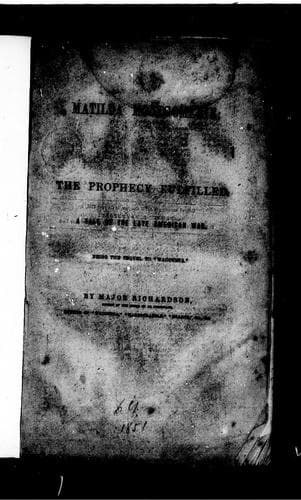
Matilda Montgomerie; Or, The Prophecy FulfilledRichardson, Major (John)
History
Matilda Montgomerie; Or, The Prophecy Fulfilled
Richardson, Major (John)
United States -- History -- War of 1812 -- Fiction
Both Grantham and Middlemore looked their utter surprise at the language
thus used by Captain Molineux, but neither of them spoke.
"If an apology the most ample for my observation of yesterday,"
continued that officer, "an apology founded on my perfect conviction of
error, (that conviction produced by certain recent explanations with
your brother), can satisfy you, Mr. Grantham, most sincerely do I make
it. If, however, you hold me to my pledge, here am I of course to redeem
it. I may as well observe to you in the presence of our friends, (and
Villiers can corroborate my statement), that my original intention on
leaving your brother, was to receive your fire and then tender my
apology, but, under the circumstances in which both you and Middlemore
are placed at this moment, the idea would be altogether absurd. Again I
tender my apology, which it will be a satisfaction to me to repeat this
day at the mess table, where I yesterday refused to drink your brother's
health. All I can add is that when you have heard the motives for my
conduct, and learnt to what extent I have been deceived, you will
readily admit that I acted not altogether from caprice."
"Your apology I accept, Captain Molineux," said Grantham, coming forward
and unhesitatingly offering his hand. "If you have seen my brother, I am
satisfied. Let there be no further question on the subject."
"So then I am to be the only bulleted man on this occasion," interrupted
Middlemore, with ludicrous pathos--"the only poor devil who is to be
made to remember Hartley's point for ever. But no matter. I am not the
first instance of a second being shot, through the awkward bungling of
his principal, and certainly Grantham you were in every sense the
principal in this affair, for had you taken my advice you would have let
the fellows go to the devil their own way."
"What! knowing, as I did, that the traitor Desborough had concealed in
his canoe a prisoner on parole--nay, worse, a deserter from our
service--with a view of conveying him out of the country."
"How did you know it."
"Because I at once recognised him, through the disguise in which he left
the hut, for what he was. That discovery made, there remained but one
course to pursue."
"Ah! and coarse work you made of it, with a vengeance," said Middlemore,
"first started him up like a fox from his cover, got the mark of his
teeth, and then suffered him to escape."
"Is there no chance of following--no means of overtaking them?" said
Captain Molineux--"No, by Heaven," as he glanced his eye from right to
left, "not a single canoe to be seen anywhere along the shore."
"Following!" echoed Middlemore; "faith the scoundrels would desire
nothing better: if two of us had such indifferent play with them on
terra firma, you may rely upon it that double the number would have no
better chance in one of these rickety canoes. See there how the rascals
lie to within half musket shot, apparently hailing us."
Public-domain text, read in full here on John Shaqi.
Reviews
Reviews
No reviews yet
Be the first to share your thoughts on this work.
Elsewhere in the archive
Join the Discussion
Join the discussion
Sign in to leave a comment or review.
Sign InorCreate an account