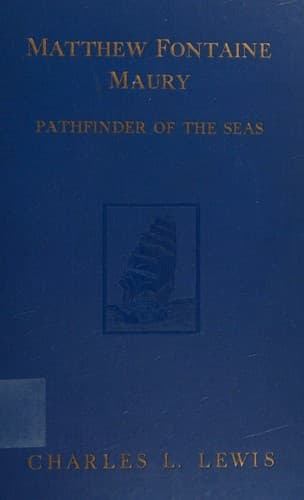
Matthew Fontaine Maury, the Pathfinder of the SeasLewis, Charles Lee
History
Matthew Fontaine Maury, the Pathfinder of the Seas
Lewis, Charles Lee
Maury, Matthew Fontaine, 1806-1873
This invitation, coming at a time when Maury was being thwarted in his
efforts to serve the Confederacy, must have been a great temptation.
But he did not hesitate in declining the offer; he had cast his lot
with Virginia and through her with the Confederacy. One of his
daughters relates how he came to Fredericksburg to tell his wife and
children of the offer and its rejection. There were two letters. “One
was from His Imperial Highness, the Grand Duke Constantine, Grand
Admiral of Russia”, she wrote, “and one from Baron Stoeckle, Russian
Ambassador in Washington, telling him how and by what route he was to
travel to Russia, where he was to go for passports, money, advice, and
information. My father was now fifty-seven years old. Every maritime
nation of Europe had given him evidences of their appreciation of the
benefits that their commerce had received from the use of his Wind and
Current Charts and Sailing Directions. He read that correspondence to
us in my mother’s bedroom, all of us gathered around him, before the
wood fire, the young ones leaning against him looking into his face
with eager questioning eyes as he read that princely offer, and told us
he would not go”.
In his courteous reply to this generous invitation, Maury wrote that
it was only his stern sense of duty that enabled him to withstand
such inducements as none but the most magnanimous of princes could
offer,—the hospitalities of a great and powerful Empire, with the
Grand Admiral of its fleets for patron and friend. He assured the Grand
Duke that he was grateful for the offer of a home on the banks of the
Neva, where, in the midst of books and surrounded by his family and
friends, he would be free from anxiety as to the future and have the
most princely means and facilities for prosecuting those studies and
continuing those philosophical labors in which he had taken so much
delight in former years in Washington. He then reviewed the recent
events that had taken place in the United States, and explained why
he had followed the fortunes of Virginia. “The path of duty and of
honor”, he wrote in closing, “is therefore plain. By following it with
the devotion and loyalty of a true sailor I shall, I am persuaded, have
the glorious and proud recompense that is contained in the ‘well done’
of the Grand Admiral and his noble companions-in-arms. When the invader
is expelled, and as soon thereafter as the State will grant me leave,
I promise myself the pleasure of a trip across the Atlantic, and shall
hasten to Russia that I may there in person, on the banks of the Neva,
have the honor and the pleasure of expressing to her Grand Admiral the
sentiments of respect and esteem with which his oft-repeated acts of
kindness, and the generous encouragement that he has afforded me in the
pursuits of science have inspired his—Obedient servant, M. F. Maury,
Commander, C. S. Navy”.
Public-domain text, read in full here on John Shaqi.
Reviews
Reviews
No reviews yet
Be the first to share your thoughts on this work.
Elsewhere in the archive
Join the Discussion
Join the discussion
Sign in to leave a comment or review.
Sign InorCreate an account