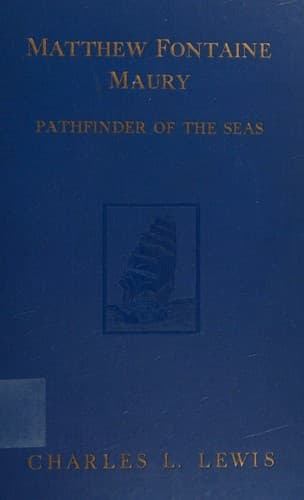
Matthew Fontaine Maury, the Pathfinder of the SeasLewis, Charles Lee
History
Matthew Fontaine Maury, the Pathfinder of the Seas
Lewis, Charles Lee
Maury, Matthew Fontaine, 1806-1873
Here it should be said that, in the matter of cinchona cultivation,
Maury left a lasting blessing to Mexico. Before leaving England in
1865, he had discussed the possibility of the introduction of this
febrifuge-yielding tree into certain mountainous districts of Mexico,
with Mr. Clements Markham, who had established the cinchona plantations
in India and was then in charge of all matters relating to them in the
India Office. The feasibility of such an introduction of the plant
having been agreed to, Maury on his return to England secured three
packets of seeds from Markham, which were sent to Mexico, and from
them successful plantations were established near Cordoba and in other
sections of the country. Thus Maury left a living monument to himself
in the country of his adoption and short residence.
Though the letters of both the Emperor and the Empress indicate an
expectation of Maury’s return to Mexico, yet in a letter to his wife,
written before his departure, he leaves the impression that conditions
in that country might not render this advisable. It was also understood
by some of his friends in the United States that he was going to
England to assist in the laying of a telegraph cable from England to
the West Indies and Mexico, and his son Richard thought his father
would not return if the cable succeeded. Though Maury did not become
connected with this enterprise, yet there developed in Mexico very
soon after his departure conditions which made his return inadvisable.
In fact, events in that unhappy country were fast moving toward
Maximilian’s tragic end; and Maury was destined never to see that
country nor its unfortunate rulers again.
CHAPTER XIV
REUNITED WITH HIS FAMILY IN ENGLAND
Maury arrived in England from Mexico, on March 29, 1866, and was once
more united with his wife and younger children in London, at No. 30
Harley Street. His appearance had been so completely changed by the
sorrows, hardships, and anxieties of the long years of separation that
none of his children knew him. Indeed, his youngest daughter, on seeing
him for the first time after his arrival, exclaimed, “This is not my
papa! This is an old man with a white beard!”
Public-domain text, read in full here on John Shaqi.
Reviews
Reviews
No reviews yet
Be the first to share your thoughts on this work.
Elsewhere in the archive
Join the Discussion
Join the discussion
Sign in to leave a comment or review.
Sign InorCreate an account