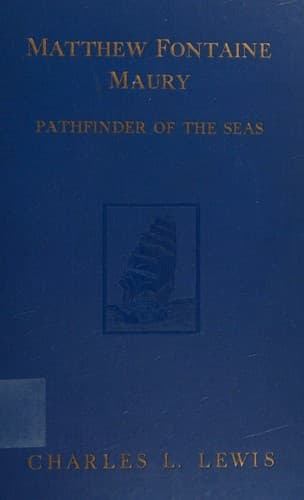
Matthew Fontaine Maury, the Pathfinder of the SeasLewis, Charles Lee
History
Matthew Fontaine Maury, the Pathfinder of the Seas
Lewis, Charles Lee
Maury, Matthew Fontaine, 1806-1873
to the United States at the earliest opportunity, and he accordingly
declined the offer.
In July, 1866 representatives from Sweden and Norway, and Holland
came to London to be instructed. There is some evidence that Russia
and England also sent representatives at this time. “I have a school
under weigh”, humorously wrote Maury, “with Sweden and Norway as
pupils—board and tuition 500 pounds. They will graduate in ‘sea
mining’ this week. Monday the 16th, the school opens for the Dutch at
500 pounds. I have heard no more about turning Frenchman. But the King
of Wurttemberg has been pestering me to keep the Prussians out of his
pea-patch of a kingdom. ‘Barkis is willing’, but I can’t say whether
anything will come out of it; I think not as the war looks like it is
drawing to a close”.
The lectures which Maury gave in connection with the demonstrations
of his mines gave an introductory sketch of all that his predecessors
since the time of Priestly had done in this field, an account of all
that had been accomplished by the South with this new weapon during the
late war, and then in detail the results of his own experiments. As
far as the submarine mine was concerned, he added nothing new to what
he had set down in the agreement with Holmes which was drawn up by him
just before leaving England near the close of the war. But as to their
use on land, the following details appear for the first time among his
papers: “After this hasty sketch, I come to electrical torpedoes for
guarding mountain passes and roadways, etc., for the protection of
strongholds and the defense of fortified positions. Shells cast for
the purpose should be used, but in an emergency tin canisters, or any
other perfectly water-tight cases, will answer. I am not aware that
electricity was used by either of the belligerents in the late American
war for springing mines on land.
“The cases for land-torpedoes should be shells cast expressly for the
purpose. The thickness of the shell being from one-fourth to an inch,
and even more, or less, according to the size and the probable handling
in transportation.
Public-domain text, read in full here on John Shaqi.
Reviews
Reviews
No reviews yet
Be the first to share your thoughts on this work.
Elsewhere in the archive
Join the Discussion
Join the discussion
Sign in to leave a comment or review.
Sign InorCreate an account