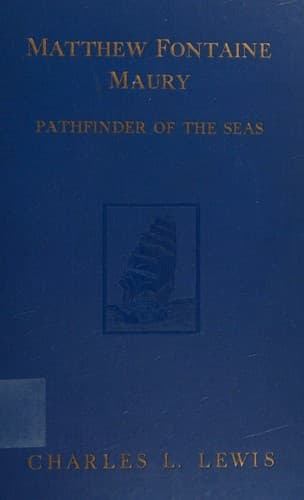
Matthew Fontaine Maury, the Pathfinder of the SeasLewis, Charles Lee
History
Matthew Fontaine Maury, the Pathfinder of the Seas
Lewis, Charles Lee
Maury, Matthew Fontaine, 1806-1873
When Maury went with his family to Lexington to reside, he was greatly
pleased with his new home. “Here we are”, he wrote, “in our new home,
busy fixing up; and things begin to know their places. So we also
begin to have a home-feeling. People are very kind, the country is
beautiful, the views and the scenery lovely, and both climate and air
such that exercise is enjoyment”. In these congenial surroundings he
set to work with a will in the performance of his new duties, special
attention being given to the making of the physical survey of Virginia.
The object of this work was twofold; namely, to hasten the development
of all the state’s natural resources, agricultural and mineral, and
to remove prejudice against the South so that immigrants would be
attracted to the deserted farms. As in the old days at the Observatory,
when he was investigating the winds and currents, Maury brought into
play his power of inspiring others with enthusiastic coöperation, and
soon reports and communications came pouring into his office at the
Institute from all parts of the state. There was some rivalry, in the
matter of the survey, between Washington College and Virginia Military
Institute. Maury declared that the College tried to steal his thunder,
and that he published what was called a “Preliminary Report” in order
to “knock them on the head”. The complete survey was unfinished at the
time of his death; but a portion of it was published by his son Matthew
in 1878.
Maury also continued work on his geographical series, only the first
two books of which had been published before he left England. The
“Academic Geography” of the original plan was abandoned; but in
1871 his “Manual of Geography” appeared, and in 1873 his “Physical
Geography”. The first was very favorably received. One review dwelt
particularly on the author’s power of making a tedious and dry subject
interesting and agreeable, commended the illustrations, and declared
that the book would delight any schoolroom in which the teacher is not
hopelessly unfit to teach. “We are sure”, it continued, “that where it
is adopted the geography lesson will become suddenly and surprisingly
popular”. The preface to the edition, which was revised by Mytton
Maury and re-copyrighted in 1880 by the University Publishing Company,
stated, “Among the marked excellences of the early edition was its
presentation of geography in the character of a science rather than an
assemblage of disconnected facts. Land and air and ocean were treated
as parts of a grand mechanism; rivers were discussed not simply as
‘divisions of water’ but as having definite ‘offices’ to perform;
mountains were not merely masses of a certain altitude, but regulators
of rainfall. It was also carefully pointed out how the geographical
position and climate of a country determine its industries. Trade was
shown to be in a special manner under the influence of geographical
law”.
Public-domain text, read in full here on John Shaqi.
Reviews
Reviews
No reviews yet
Be the first to share your thoughts on this work.
Elsewhere in the archive
Join the Discussion
Join the discussion
Sign in to leave a comment or review.
Sign InorCreate an account