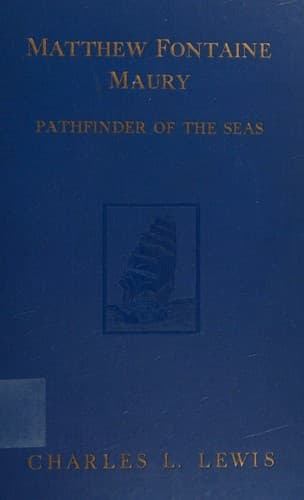
Matthew Fontaine Maury, the Pathfinder of the SeasLewis, Charles Lee
History
Matthew Fontaine Maury, the Pathfinder of the Seas
Lewis, Charles Lee
Maury, Matthew Fontaine, 1806-1873
All of these memorials, so varied in their nature and so widely
distributed, would seem to indicate that Maury’s name is by no means
likely to be forgotten. Still, his name and his achievements are not
so generally known, even in the United States, as they deserve to be.
“For myself”, wrote Julian Street[31] a few years ago, “I must confess
that, until I visited Virginia, I was ignorant of the fact that such
a person had existed; nor have Northern schoolboys, to whom I have
spoken of Maury, so much as heard his name. Yet there is not one living
in the United States or in any civilized country, whose daily life is
not affected through the scientific researches and attainments of this
man”. One is surprised, however, sometimes to find foreign authors
more familiar with Maury’s name, and to meet with references to him
where one might least expect any knowledge of his scientific work. For
example, in Walter de la Mare’s “Memoirs of a Midget” (p. 226), the
reader is unexpectedly confronted with this: “I searched Mrs. Bowater’s
library for views of the sea, but without much reward. So I read over
Mr. Bowater’s Captain Maury—on the winds and monsoons and tide-rips
and hurricanes, freshened up my _Robinson Crusoe_, and dreamed of the
Angels with the Vials”. Another example, almost equally unexpected is
to be found in Vicente Blasco Ibanez’s “Mare Nostrum” (p. 65). “He
(Ulysses) had learned English”, writes Ibanez, “the universal language
of the blue dominions, and was refreshing himself with a study of
Maury’s charts—the sailor’s Bible—the patient work of an obscure
genius who first snatched from ocean and atmosphere the secret of their
laws”.
In recent scientific works, however, such as “The Depths of the Sea”
by Sir John Murray and Dr. Johan Hjort, “Science of the Sea” edited by
G. Herbert Fowler, and “Founders of Oceanography” by Sir William A.
Herdman one is not surprised to find full justification for referring
to Maury as “The Pathfinder of the Seas”, for marine meteorology,
they declare, may be said to date from his time. Not only is this
title appropriate in that Maury laid out on his charts the best tracks
for voyagers to follow on the Seven Seas, but it is also fitting in
a figurative sense for he was indeed a pathfinder in the realm of a
new science,—the physical geography of the sea. This phrase was,
therefore, rightly chosen to be placed on the memorial tablet in Goshen
Pass as well as on the one at Franklin, Tennessee, and it is to be
prominently inscribed on the monument soon to be erected to him in
Richmond. This beautifully poetic title, “The Pathfinder of the Seas”,
will be his real monument against which the tooth of time will gnaw in
vain, for it will rest solidly based upon his original contributions to
the science of the world: “The Physical Geography of the Sea” and the
“Wind and Current Charts” with their “Sailing Directions”.
Public-domain text, read in full here on John Shaqi.
Reviews
Reviews
No reviews yet
Be the first to share your thoughts on this work.
Elsewhere in the archive
Join the Discussion
Join the discussion
Sign in to leave a comment or review.
Sign InorCreate an account