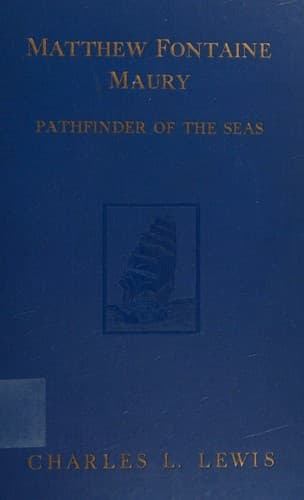
Matthew Fontaine Maury, the Pathfinder of the SeasLewis, Charles Lee
History
Matthew Fontaine Maury, the Pathfinder of the Seas
Lewis, Charles Lee
Maury, Matthew Fontaine, 1806-1873
Navigation of the Strait of Belleisle by the trans-Atlantic trades
ordinarily ceases about November 25, although the average formation of
local ice is some two weeks later. In the River St. Lawrence the close
of navigation occurs during the last week in November.
=3.= NORTH ATLANTIC LANE ROUTES—UNITED STATES
In accordance with the North Atlantic Track Agreement, the Hydrographic
Office advises that the North Atlantic Lane Routes, agreed to in Oct.
1924, by the principal steamship companies, shown on this chart in full
black lines are effective as follows:
TRACK C EASTBOUND.—Cross longitude 50° in latitude 42° from Sept. 1
to Jan. 31 inclusive.
WESTBOUND.—Cross longitude 50° in latitude 43° from Sept. 1
to Jan. 31 inclusive.
Vessels bound to or from United States ports calling at Halifax
have the option of following either the Canadian or United States
seasonal tracks to or from that port, passing 40 miles south of Sable
Island westbound, and 60 miles south of Sable Island eastbound,
when proceeding on U. S. tracks, or 20 miles south of Sable Island
eastbound, when proceeding on Canadian tracks.
Vessels bound direct to Portland (Maine) may follow the Canadian
Seasonal tracks.
NOTE.—The above routes are liable to alterations when, owing to
abnormal ice conditions it is considered advisable by the steamship
lines who are parties to the North Atlantic Track Agreement. Notice of
these alterations will be published by the U. S. Hydrographic Office.
=4.= U. S. STORM WARNINGS.
[Illustration:
N. W. Winds
S. W. Winds
N. E. Winds
S. E. Winds
“Hurricane” Warning]
Flags 8 feet square. Pennants 5 feet hoist, 12 feet fly.
_Storm Warning Flags._—A red flag with a black center indicates that a
storm of marked violence is expected.
The pennants displayed with the flags indicate the direction of
the wind: Red, easterly; white, westerly. The pennant above the
flag indicates that the wind is expected to blow from the northerly
quadrants; below, from southerly quadrants.
By night the approach of storms of marked violence is indicated by:
Two red lights, one above the other, for winds beginning from the
northeast; a single red light for winds beginning from the southeast; a
red light above a white light for winds beginning from the southwest;
and a white light above a red light for winds beginning from the
northwest.
Public-domain text, read in full here on John Shaqi.
Reviews
Reviews
No reviews yet
Be the first to share your thoughts on this work.
Elsewhere in the archive
Join the Discussion
Join the discussion
Sign in to leave a comment or review.
Sign InorCreate an account