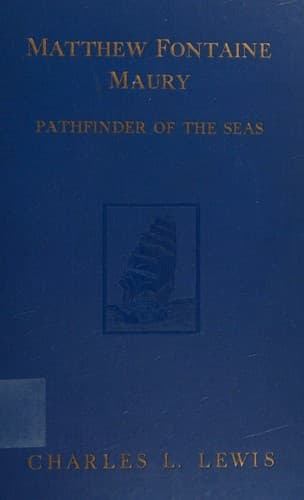
Matthew Fontaine Maury, the Pathfinder of the SeasLewis, Charles Lee
History
Matthew Fontaine Maury, the Pathfinder of the Seas
Lewis, Charles Lee
Maury, Matthew Fontaine, 1806-1873
Maury’s researches in the science of the sea could not, perhaps,
have been so fruitful in practical achievements, had there not been
at this time such a widespread desire to learn more about the ocean.
In America, it was a veritable age of geographical investigation and
discovery. In addition to the Exploring Expedition under Wilkes,
which spent three years and ten months in exploring the islands of the
Pacific and established the fact of the existence of the Antarctic
continent, there were many others of the same nature. Lieutenant
William Francis Lynch, in 1847–1848, led an expedition which surveyed
the Dead Sea; in 1850–1851, Lieutenant Edward J. De Haven commanded a
squadron which went into the Arctic in search of Sir John Franklin,
and though unsuccessful in finding the English explorer, he made
important scientific discoveries; Commander Cadwalader Ringgold, during
1853–1854, and then Commander John Rodgers, in the following years
1855–1856, explored and surveyed Bering Strait, the North Pacific
Ocean, and the China Seas; and in 1853, Dr. Elisha K. Kane, U. S.
Navy led another expedition into the Arctic regions in search of
Franklin and off Greenland reached a stretch of water which he thought
confirmed Maury’s theory as to an open polar sea. Between 1848 and
1852, Lieutenant John P. Gilliss conducted an astronomical expedition
to Chile, Lieutenant Archibald McRae traversed the Pampas from Chile
to Buenos Ayres, Lieutenant Isaac G. Strain explored the Isthmus of
Darien, Lieutenant Richard L. Page investigated the La Plata and its
tributaries, and Lieutenant William Lewis Herndon made his famous trip
across South America from the west coast to the headwaters of the
Amazon and then down that stream to the Atlantic. Furthermore, it was
at about this same time that Commodore Matthew Calbraith Perry went
to Japan and by skillful diplomacy opened up that country to western
civilization.
Maury simply reveled in the results of these various explorations,
and his writings are filled with references to them. He knew all the
explorers personally, and furnished many of them with helpful advice
and encouragement in their undertakings,—especially Kane, De Haven,
Lynch, and Herndon. Dr. Kane wished to name the open polar sea after
Maury; but he waived the honor and wrote to Kane that he should yield
to his friends and let “his name go upon the waters”, and to-day it is
known as Kane Basin.
Maury’s investigations into the habits and nature of whales had led him
to conclude that there was really a Northwest Passage as well as open
water about the North Pole. The former theory was proved by Commander
McClure of H. M. S. _Investigator_, July 31, 1850 to April 6, 1853,
when he passed from west to east through the northern waters, and
settled the question. As to the polar sea, it is interesting to note in
passing that only recently two explorers of the air, Byrd and Amundson,
both verified the truth of Maury’s theory.
Public-domain text, read in full here on John Shaqi.
Reviews
Reviews
No reviews yet
Be the first to share your thoughts on this work.
Elsewhere in the archive
Join the Discussion
Join the discussion
Sign in to leave a comment or review.
Sign InorCreate an account