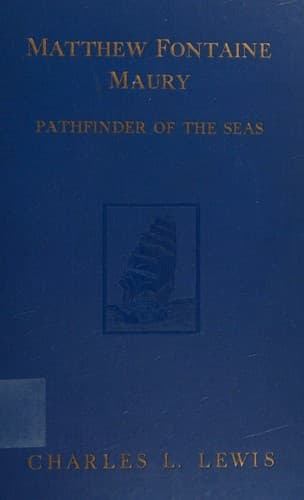
Matthew Fontaine Maury, the Pathfinder of the SeasLewis, Charles Lee
History
Matthew Fontaine Maury, the Pathfinder of the Seas
Lewis, Charles Lee
Maury, Matthew Fontaine, 1806-1873
As regards the Antarctic regions, Maury called upon the nations of
the world to coöperate in sending an expedition there. “Ho for the
South Pole” was his slogan. “It is enough for me”, he wrote, “when
contemplating the vast extent of that unknown region, to know that
it is a part of the surface of our planet, and to remember that _the
earth was made for man_; that all knowledge is profitable; that no
discoveries have conferred more honor and glory upon the age in which
they were made, or been more beneficial to the world than geographical
discoveries; and that never were nations so well prepared to undertake
Antarctic exploration as are those that I now solicit”. Though the
Civil War interfered with the carrying out of plans for the exploring
of that portion of the globe, yet Maury’s name deserves to be
remembered among those whose continued interest in this enterprise
finally led to the conquering of the South Pole.
Another contribution which Maury made was the laying down of lanes for
steamers in the North Atlantic. The idea originated with R. B. Forbes
of Boston, but was worked out scientifically by Maury. In the year
1855, at the instigation of a board of underwriters of New York, who
paid for its cost, he published a chart illustrating what he called
Ocean Lanes. To prepare this chart he studied the logs of 46,000 days
of observations of the wind and weather of that part of the North
Atlantic. Two tracks, or lanes, twenty miles wide, were laid down, to
the more northern of which he proposed to confine the steamers westward
bound, while the eastward bound vessels were to use the other, situated
from one to ten degrees further south. Although the Secretary of the
Navy immediately ordered the ships of the navy to observe these lanes,
they were not generally adopted by the shipping of the world until
about thirty-six years after they were formulated, and it was not until
1898 that all of the transatlantic steamship companies consented in a
written agreement to use them. After a dispassionate investigation of
the lanes, they said that they were impressed with the patience and
researches that Maury must have made to have laid down such excellent
paths, and they recognized that, had the highways been followed
earlier, the great majority of the accidents which had befallen vessels
in the North Atlantic might have been avoided.
Public-domain text, read in full here on John Shaqi.
Reviews
Reviews
No reviews yet
Be the first to share your thoughts on this work.
Elsewhere in the archive
Join the Discussion
Join the discussion
Sign in to leave a comment or review.
Sign InorCreate an account