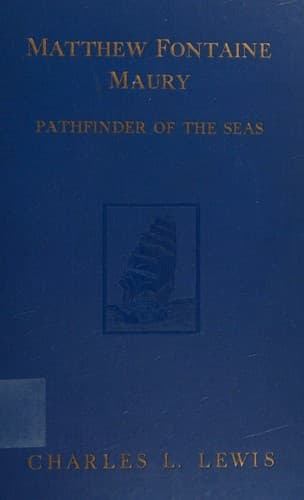
Matthew Fontaine Maury, the Pathfinder of the SeasLewis, Charles Lee
History
Matthew Fontaine Maury, the Pathfinder of the Seas
Lewis, Charles Lee
Maury, Matthew Fontaine, 1806-1873
After Congress passed on June 15, 1844, an act for establishing a naval
dockyard and depot at Memphis, Maury concentrated his batteries upon
the need for a canal to connect the Mississippi with Lake Michigan
through the Illinois River. He claimed that this would be of great
benefit to commerce in time of peace, and that, if war with England
should come, the United States would then be prepared to meet her
halfway. “Let this work be completed”, he added, “and it will be a
dragon’s tooth planted in the West to bring forth for the defense of
the country a harvest of steam-clad warriors, ever brave, always ready”.
This question he took up again at the meeting of the Memphis Convention
of Southern and Western States, on November 12, 1845, where he was
the veritable spokesman of those two sections. Another important
matter which he advocated at this convention was what was called “A
Warehousing System and Direct Trade with the South”. This, he said,
would foster shipping for Southern ports, enable ships to be loaded
both ways and thus make cheaper rates, and prevent trade in high-dutied
articles from concentrating in New York where there was the greatest
amount of ready capital on hand. Other measures which Maury urged at
this convention were the following: bakeries at Chicago for supplying
better bread for the navy, a school of engineers at Memphis, mail and
snag-boats as a nucleus for a river fleet in time of war, river marks
or gauges as an aid to safer navigation, the deepening of the river
below New Orleans at Southwest Pass, more lighthouses on the Florida
and the Gulf Coast, and a monthly mail to Oregon.
In 1851, at the request of the Secretary of the Navy, Maury wrote a
report on “Fortifications” to be referred to the House Committee on
Military Affairs. In this report he advocated for coast defense what
he called “a locomotive battery or flying artillery” to protect cities
from the “Great Guns of Big Ships”; heavy fortifications at Key West,
on the Dry Tortugas, and perhaps on Ship and Cat Islands; and the
completion of railroad connection with the Pacific and the beginning
there of the nucleus of a navy. He was opposed to floating batteries,
but favored twenty or twenty-five steam men-of-war as a home squadron
and thought some provision should be made against surprise on the
Lakes. In closing, he declared, “The ocean front of the United States
alone is greater in extent than the ocean front of the whole of Europe;
therefore, like action to the orator, a navy to us is the first,
second, and third chief requisite to any effective system of national
defense”.
Public-domain text, read in full here on John Shaqi.
Reviews
Reviews
No reviews yet
Be the first to share your thoughts on this work.
Elsewhere in the archive
Join the Discussion
Join the discussion
Sign in to leave a comment or review.
Sign InorCreate an account