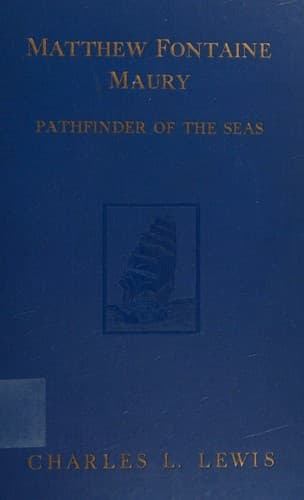
Matthew Fontaine Maury, the Pathfinder of the SeasLewis, Charles Lee
History
Matthew Fontaine Maury, the Pathfinder of the Seas
Lewis, Charles Lee
Maury, Matthew Fontaine, 1806-1873
“Here, in the schools which are soon to be opened, within the walls of
this institution which we are preparing to establish in this wood, and
the corner stone of which has just been laid, the masters of this newly
ordained science will teach our sons to regard some of the commonest
things as the most important agents in the physical economy of our
planet. They are also mighty ministers of the Creator. Take this water”
(holding up a glassful) “and ask the student of physical geography to
explain a portion only of its multitudinous offices in helping to make
the earth fit for man’s habitation. He may recognize in it a drop of
the very same which watered the Garden of Eden when Adam was there.
Escaping thence through the veins of the earth into the rivers, it
reached the sea; passing along its channels of circulation, it was
conveyed far away by its currents to those springs in the ocean which
feed the winds with vapor for rains among these mountains; taking up
the heat in these southern climes, where otherwise it would become
excessive, it bottles it away in its own little vesicles. These are
invisible; but rendering the heat latent and innocuous, they pass like
sightless couriers of the air through their appointed channels, and
arrive here in the upper sky. This mountain draws the heat from them;
they are formed into clouds and condensed into rain, which, coming to
the earth, make it ‘soft with showers’, causing the trees of the field
to clap their hands, the valleys to shout, and the mountains to sing.
Thus the earth is made to yield her increase, and the heart of man is
glad.
“Nor does the office of this cup of water in the physical economy end
here. It has brought heat from the sea in the southern hemisphere
to be set free here for the regulation of our climates; it has
ministered to the green plants, and given meat and drink to man and
beast. It has now to cater among the rocks for the fish and insects
of the sea. Eating away your mountains, it fills up the valleys, and
then, loaded with lime and salts of various minerals, it goes singing
and dancing and leaping back to the sea, owning man by the way as a
task-master—turning mills, driving machinery, transporting merchandise
for him—and finally reaching the ocean. It there joins the currents to
be conveyed to its appointed place, which it never fails to reach in
due time, with food in due quantities for the inhabitants of the deep,
and with materials of the right kind to be elaborated in the workshops
of the sea into pearls, corals, and islands—all for man’s use.
“Thus the right-minded student of this science is brought to recognize
in the dewdrop the materials of which He who ‘walketh upon the wings
of the wind’ maketh His chariot. He also discovers in the raindrop a
clue by which the Christian philosopher may be conducted into the very
chambers from which the hills are watered.
Public-domain text, read in full here on John Shaqi.
Reviews
Reviews
No reviews yet
Be the first to share your thoughts on this work.
Elsewhere in the archive
Join the Discussion
Join the discussion
Sign in to leave a comment or review.
Sign InorCreate an account