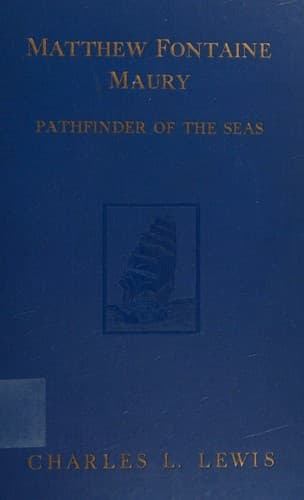
Matthew Fontaine Maury, the Pathfinder of the SeasLewis, Charles Lee
History
Matthew Fontaine Maury, the Pathfinder of the Seas
Lewis, Charles Lee
Maury, Matthew Fontaine, 1806-1873
All of this speaking and writing made Maury’s name known very widely
all over the United States, and it was but natural for some of his
friends to think of him in connection with the Presidency. They
believed that, if his adopted state, Tennessee, would heartily nominate
him, not as a party man but as a broad-minded, public-spirited citizen,
he could be easily elected, for his popularity was great with all
who did not aspire to the leadership of some particular clique. But
Maury did not like politics, and besides Fate had in store for him
an entirely different future. However, in the light of his attitude
toward slavery and the preservation of the Union it is interesting to
speculate on how different the history of the United States might have
been, had he been elevated to this high office.
[Illustration: MATTHEW FONTAINE MAURY
This painting, by E. Sophonisba Hergesheimer, was presented in
1923 to the United States Naval Academy by the United Daughters
of the Confederacy, Atlanta Chapter, Georgia Division. It hangs
over the entrance to the Maury Hall wing of the Academic Group of
buildings.]
CHAPTER VIII
HIS TREATMENT BY THE “RETIRING BOARD”
It must not be supposed that Maury spent only halcyon days during
his long period of service at the Naval Observatory. When it is
remembered that his contacts with men were extremely numerous, and
that the opportunities for unpleasant controversy were almost without
number in view of the fact that he was such an ardent advocate of
whatever question he took up, whether it was scientific, economic, or
political, it is truly remarkable that there were so few who became
hostile to him. But strange as it may seem, those who as a class
were most unfriendly to Maury and least sympathetic toward his work
were a considerable number of his brother officers in the navy. As a
consequence, in the year 1855, a board of naval officers inflicted upon
him painful mental sufferings and placed him in a humiliating position,
at the very time when his name was being acclaimed by the scientists
and many of the rulers of foreign countries.
The occasion for the display of this enmity against Maury was the
passing of the Act of Congress of February 28, 1855, to “promote the
efficiency of the navy”. To carry out this law, the President assembled
a board of naval officers consisting of five captains, five commanders,
and five lieutenants, to “make a careful examination” of the personnel
of the navy and report those found “incapable of performing promptly
and efficiently all their duty both ashore and afloat”. Those so
reported were to be either dropped from the rolls of the navy or
placed upon what was to be called the “reserved list” and receive
either leave of absence pay or furlough pay, according to the degree
of their disability; they were, moreover, to be ineligible for further
promotion, and subject at all times to the Navy Department for duty.
Public-domain text, read in full here on John Shaqi.
Reviews
Reviews
No reviews yet
Be the first to share your thoughts on this work.
Elsewhere in the archive
Join the Discussion
Join the discussion
Sign in to leave a comment or review.
Sign InorCreate an account