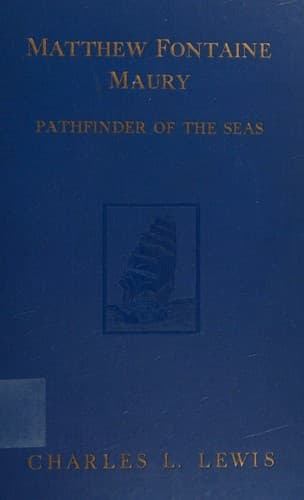
Matthew Fontaine Maury, the Pathfinder of the SeasLewis, Charles Lee
History
Matthew Fontaine Maury, the Pathfinder of the Seas
Lewis, Charles Lee
Maury, Matthew Fontaine, 1806-1873
Maury had a very modest estimate of his own work. He did not claim
to have discovered anything. “I only bring together”, he wrote,
“the observations that others have made, and then leave it to the
observations themselves to discover their own meaning in their own way.
Sometimes, indeed, I do become the mouthpiece of these observations and
proclaim to the world what they reveal to me. But in this I consider
myself merely as an instrument. I am fortunate, indeed, when I succeed
in rightly interpreting the meaning of the observations, and am happy
always to find concurrence in the opinions expressed or entertained by
older and wiser”. His investigations on every subject were directed
toward some practical benefit to his fellowmen, and he often quoted
with appreciation the saying that he who made two blades of grass grow
where only one had grown before was a benefactor to the world.
This practical attitude toward his work and toward life in general
led Maury to have very definite ideas about education. These appeared
to some extent in his scheme for a Naval School, but they were more
fully revealed in his letters. Latin and Greek, he thought, should not
be given the place of first importance as compared with mathematics
and chemistry, and he declared that West Point was the only tolerable
institution in the United States because of the absence there of the
humbuggery of the Learned Languages. Female seminaries he considered
to be “downright cheats” because of the superficiality of the
knowledge imparted there. He was opposed to the neglect of the study
of English, so prevalent in the schools and colleges of his day, and
thought that Spanish, French, and German were languages well worthy of
study. Naturally, he laid great stress on the value of mathematical,
geographical, and other scientific studies. “As for the sciences”, he
declared, “more is now annually developed in every department thereof
than was ever known, dreamed, or thought of, by the ancients”.
Maury himself had been largely self-educated, but his speeches as well
as his writings show that he had read widely and discriminatingly. He
was well read not only in science and naval history and biography,
but also in the classics, and often quoted passages from Shakespeare,
Byron, Dante, and the Bible; in the course of a single speech he
referred intelligently to Plato, Plutarch, Seneca, Goethe, Bacon,
Newton, and other authors. He is said to have been fond of reading
aloud to his family from Scott’s novels and poems, Shakespeare’s
plays, and the works of many other British poets, particularly
Wordsworth and Mrs. Hemans.
Public-domain text, read in full here on John Shaqi.
Reviews
Reviews
No reviews yet
Be the first to share your thoughts on this work.
Elsewhere in the archive
Join the Discussion
Join the discussion
Sign in to leave a comment or review.
Sign InorCreate an account