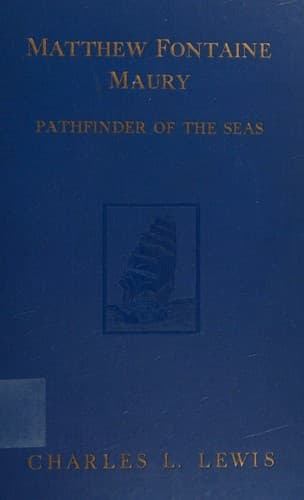
Matthew Fontaine Maury, the Pathfinder of the SeasLewis, Charles Lee
History
Matthew Fontaine Maury, the Pathfinder of the Seas
Lewis, Charles Lee
Maury, Matthew Fontaine, 1806-1873
“Make it a rule never to offend, nor to seek cause of offense in the
conduct of others. Be polite to all, familiar with but few. Do not
be quick to take offense; you will never find a gentleman who will
willfully and without any cause, real or imaginary, offend another.
Therefore whenever you imagine yourself aggrieved either by an equal or
a superior officer—when you are in doubt as to whether the offense
were intended or not, go straight up to him, state the case, and ask
the meaning of the intention. Never let imaginary offenses, slights,
or cuts find a place in your breast—they sour the disposition. Ask to
have them explained at once, and in asking be always polite—never show
temper.
“The rule in the navy is to treat everybody as a gentleman until he
proves himself otherwise. It is a good rule—observe it well. You will
sometimes hear the opinion expressed that it is necessary for a young
officer to establish his courage by fighting. Now believe me, my young
friend, that the courage to stand up and be shot at is the poorest sort
of courage. He only is truly brave who has the courage to do right.
This is the highest quality of bravery that a military, or any other
man can possess.
“The doing right, the acting up to the principle, may sometimes seem
to you to be inexpedient, or it may have the appearance of making you
unpopular—but this principle of conduct will build up a character
founded on the rock which nothing can shake; and let me assure you that
it is unwise and always wrong for a man to have enmity in his breast
between himself and his conscience. When principle is involved, be deaf
to expediency. It is a dangerous word to all classes of men. I would,
if I could, teach you almost to hate it.”
Now, a man who could attract and hold friends as Maury did would
naturally be one whose family life was a happy one. This, indeed, was
true in his case. He was a faithful son who made his home that of his
parents in their old age, a thoughtful and considerate brother to
his sisters and brothers, even sharing his home for a time with his
brother’s widow and her children and often having other relatives
under his roof. To his wife and children, Maury was their perfect ideal
of a husband and father; while to him the happiest of all places was
his home, and when he was away from it his mind was constantly filled
with thoughts of his family. Many of his letters to friends contain
references to his children, whose childish sayings he never tired of
repeating.
Public-domain text, read in full here on John Shaqi.
Reviews
Reviews
No reviews yet
Be the first to share your thoughts on this work.
Elsewhere in the archive
Join the Discussion
Join the discussion
Sign in to leave a comment or review.
Sign InorCreate an account