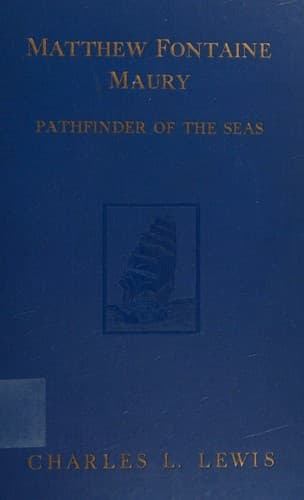
Matthew Fontaine Maury, the Pathfinder of the SeasLewis, Charles Lee
History
Matthew Fontaine Maury, the Pathfinder of the Seas
Lewis, Charles Lee
Maury, Matthew Fontaine, 1806-1873
The account of his home life continues as follows: “Whether writing or
thinking, no noise of the children, no invasion of visitors, was ever
an interruption. In the midst of his most interesting pursuits, on
which he was concentrating his powers, he would lay down his pen and
join in the laugh at a good joke, and encourage the mirth to go on.
He had an ever-active sense of humor; but scandal and gossip he would
not allow in his presence, and he would never pass over any violation
of high principle. He made loving companions and friends of his
children—in his walks, in his talks, in his work, in his recreation,
he was always one of them. He invited their confidence, and freely gave
them his; in that household there were no secrets—any step that was
about to be taken, any journey made, or any work projected, was fully
and freely talked over and discussed in family conclave. And yet his
word was law; that no one ever dreamt of disputing: so he was always
the last to speak in these family councils, and gave the ‘casting
vote’, as he used to say; the youngest voting or giving their opinion
first on the matter under discussion.
“Most of his voluminous writings were thus freely submitted to the
family council, or copied by them, and each one invited and encouraged
to criticise; and thus, not only were they made familiar with the
workings of his mind but were taught to express their own thoughts.
He wrote or composed and dictated his greatest books in his parlor,
surrounded by his family, and it seemed sometimes as if he possessed
a dual consciousness, so quickly could he abstract or concentrate his
mind upon his writing.
“Like few great men, he was the greater the closer one got to him.
Little children approached him confidingly, and never left him without
bearing away some good lesson, so gently and simply taught as to be
forever planted in their young minds. His especial pleasure was to say
a kind word and lend a helping hand to young men beginning the battle
of life. Above all men, he knew the value of praise as an incentive to
high endeavor, and when he had occasion to censure or criticise, he did
it with such obvious reluctance that it never failed to do the good
intended. While at home, he had been taught to respect women, to love
the truth, and to reverence God; and these teachings he never forgot.
“One of his daughters writes as follows: ‘He never had a study or
anything like a sanctum, where his wife and children could not come,
preferring to work in the midst of them wherever they congregated. He
would sit at the round marble-topped center table, with his papers
spread out, the bright light falling on his bald head and shining on
his brown curls, while he sat unconscious of what was going on around
him; whether it was music, or dancing, or reading aloud, or romping, he
would write away, or read what he had written, or talk to himself and
shake his head’.
Public-domain text, read in full here on John Shaqi.
Reviews
Reviews
No reviews yet
Be the first to share your thoughts on this work.
Elsewhere in the archive
Join the Discussion
Join the discussion
Sign in to leave a comment or review.
Sign InorCreate an account