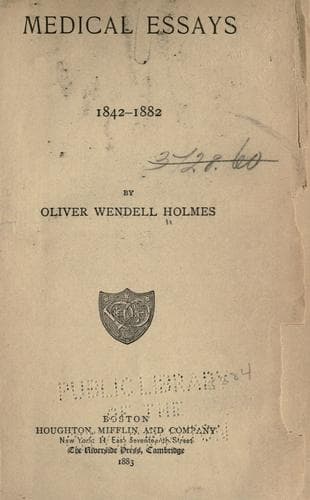
Education, Medical -- Massachusetts -- 19th century; Homeopathy; Libraries, Medical -- Massachusetts -- 19th century; Medicine
Peddle.--The five or six cases of Dr. Sidey, followed by the four of Dr.
Simpson, did not end the series. A practitioner in Leith having examined
in Dr. Simpson's house, a portion of the uterus obtained from one of
the patients, had immediately afterwards three fatal cases of puerperal
fever. Dr. Veddie referred to two distinct series of consecutive cases
in his own practice. He had since taken precautions, and not met with
any such cases. Am. Jour. Med. Sc., October, 1851.
Copland. Considers it proved that puerperal fever maybe propagated by
the hands and the clothes, or either, of a third person, the bed-clothes
or body-clothes of a patient. Mentions a new series of cases, one of
which he saw, with the practitioner who had attended them. She was the
sixth he had had within a few days. All died. Dr. Copland insisted that
contagion had caused these cases; advised precautionary measures, and
the practitioner had no other cases for a considerable time. Considers
it criminal, after the evidence adduced,--which he could have
quadrupled,--and the weight of authority brought forward, for a
practitioner to be the medium of transmitting contagion and death to
his patients. Dr. Copland lays down rules similar to those suggested
by myself, and is therefore entitled to the same epithet for so doing.
Medical Dictionary, New York, 1852. Article, Puerperal States and
Diseases.
If there is any appetite for facts so craving as to be yet
unappeased,--Lesotho, necdum satiata,--more can be obtained. Dr. Hodge
remarks that “the frequency and importance of this singular circumstance
(that the disease is occasionally more prevalent with one practitioner
than another) has been exceedingly overrated.” More than thirty strings
of cases, more than two hundred and fifty sufferers from puerperal
fever, more than one hundred and thirty deaths appear as the results of
a sparing estimate of such among the facts I have gleaned as could be
numerically valued. These facts constitute, we may take it for granted,
but a small fraction of those that have actually occurred. The number of
them might be greater, but “'t is enough, 't will serve,” in Mercutio's
modest phrase, so far as frequency is concerned. For a just estimate
of the importance of the singular circumstance, it might be proper to
consult the languid survivors, the widowed husbands, and the motherless
children, as well as “the unfortunate accoucheur.”
CURRENTS AND COUNTER-CURRENTS IN MEDICAL SCIENCE
An Address delivered before the Massachusetts Medical Society, at the
Annual Meeting, May 30, 1860.
“Facultate magis quam violentia.”
HIPPOCRATES.
Our Annual Meeting never fails to teach us at least one lesson. The art
whose province it is to heal and to save cannot protect its own ranks
from the inroads of disease and the waste of the Destroyer.
Public-domain text, read in full here on John Shaqi.
Reviews
Reviews
No reviews yet
Be the first to share your thoughts on this work.
Elsewhere in the archive
Join the Discussion
Join the discussion
Sign in to leave a comment or review.
Sign InorCreate an account