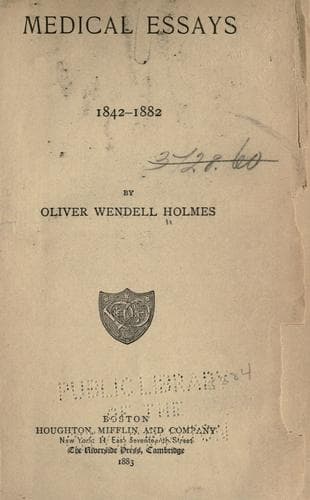
Education, Medical -- Massachusetts -- 19th century; Homeopathy; Libraries, Medical -- Massachusetts -- 19th century; Medicine
Besides all this, here are we, the great body of teachers in the
numberless medical schools of the Union, some of us lecturing to crowds
who clap and stamp in the cities, some of us wandering over the country,
like other professional fertilizers, to fecundate the minds of less
demonstrative audiences at various scientific stations; all of us
talking habitually to those supposed to know less than ourselves, and
loving to claim as much for our art as we can, not to say for our own
schools, and possibly indirectly for our own practical skill. Hence that
annual crop of introductory lectures; the useful blossoming into the
ornamental, as the cabbage becomes glorified in the cauliflower; that
lecture-room literature of adjectives, that declamatory exaggeration,
that splendid show of erudition borrowed from D'Israeli, and credited
to Lord Bacon and the rest, which have suggested to our friends of
the Medical Journals an occasional epigram at our expense. Hence the
tendency in these productions, and in medical lectures generally,
to overstate the efficacy of favorite methods of cure, and hence the
premium offered for showy talkers rather than sagacious observers,
for the men of adjectives rather than of nouns substantive in the more
ambitious of these institutions.
Such are some of the eddies in which we are liable to become involved
and carried back out of the broad stream of philosophical, or, in other
words, truth-loving, investigations. The causes of disease, in the mean
time, have been less earnestly studied in the eagerness of the search
for remedies. Speak softly! Women have been borne out from an old-world
hospital, two in one coffin, that the horrors of their prison-house
might not be known, while the very men who were discussing the treatment
of the disease were stupidly conveying the infection from bed to bed,
as rat-killers carry their poisons from one household to another. Do not
some of you remember that I have had to fight this private-pestilence
question against a scepticism which sneered in the face of a mass of
evidence such as the calm statisticians of the Insurance office could
not listen to without horror and indignation? [“The Contagiousness of
Puerperal Fever.”--N. E. Quar. Jour. of Medicine and Surgery, April,
1843. Reprinted, with Additions. Boston: Ticknor & Fields. 1855.] Have
we forgotten what is told in one of the books published under our own
sanction, that a simple measure of ventilation, proposed by Dr. John
Clark, had saved more than sixteen thousand children's lives in a
single hospital? How long would it have taken small doses of calomel and
rhubarb to save as many children? These may be useful in prudent hands,
but how insignificant compared to the great hygienic conditions! Causes,
causes, and again causes,--more and more we fall back on these as the
chief objects of our attention. The shortest system of medical practice
that I know of is the oldest, but not the worst. It is older than
Public-domain text, read in full here on John Shaqi.
Reviews
Reviews
No reviews yet
Be the first to share your thoughts on this work.
Elsewhere in the archive
Join the Discussion
Join the discussion
Sign in to leave a comment or review.
Sign InorCreate an account