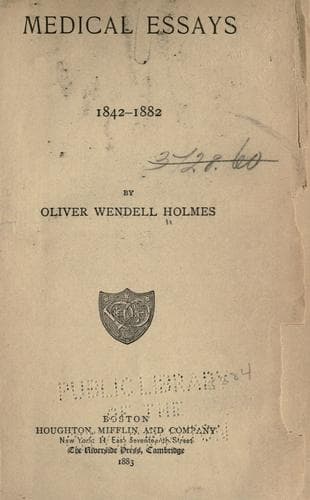
Education, Medical -- Massachusetts -- 19th century; Homeopathy; Libraries, Medical -- Massachusetts -- 19th century; Medicine
Something more than one hundred and thirty years ago there graduated at
Harvard College a delicate youth, who lived an invalid life and died at
the age of about fifty. His two children were both of moderate physical
power, and one of them diminutive in stature. The next generation rose
in physical development, and reached eighty years of age and more
in some of its members. The fourth generation was of fair average
endowment. The fifth generation, great-great-grandchildren of the
slender invalid, are several of, them of extraordinary bodily and mental
power; large in stature, formidable alike with their brains and their
arms, organized on a more extensive scale than either of their parents.
This brief account illustrates incidentally the fallacy of the
universal-degeneration theory applied to American life; the same on
which one of our countrymen has lately brought some very forcible facts
to bear in a muscular discussion of which we have heard rather more than
is good for us. But the two series, American and English, ascending and
descending, were adduced with the main purpose of showing the immense
difference of vital endowments in different strains of blood; a
difference to which all ordinary medication is in all probability a
matter of comparatively trivial purport. Many affections which art has
to strive against might be easily shown to be vital to the well-being of
society. Hydrocephalus, tabes mesenterica, and other similar maladies,
are natural agencies which cut off the children of races that are
sinking below the decent minimum which nature has established as the
condition of viability, before they reach the age of reproduction.
They are really not so much diseases, as manifestations of congenital
incapacity for life; the race would be ruined if art could ever learn
always to preserve the individuals subject to them. We must do the best
we can for them, but we ought also to know what these “diseases” mean.
Public-domain text, read in full here on John Shaqi.
Reviews
Reviews
No reviews yet
Be the first to share your thoughts on this work.
Elsewhere in the archive
Join the Discussion
Join the discussion
Sign in to leave a comment or review.
Sign InorCreate an account