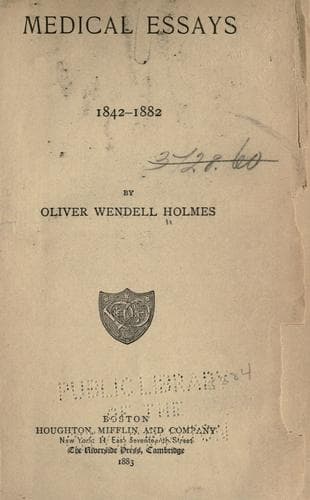
Education, Medical -- Massachusetts -- 19th century; Homeopathy; Libraries, Medical -- Massachusetts -- 19th century; Medicine
If it is true that we understand ourselves but imperfectly in health,
this truth is more signally manifested in disease, where natural actions
imperfectly understood, disturbed in an obscure way by half-seen causes,
are creeping and winding along in the dark toward their destined issue,
sometimes using our remedies as safe stepping-stones, occasionally, it
may be, stumbling over them as obstacles.
I propose in this lecture to show you some points of contact between our
ignorance and our knowledge in several of the branches upon the study
of which you are entering. I may teach you a very little directly, but I
hope much more from the trains of thought I shall suggest. Do not expect
too much ground to be covered in this rapid survey. Our task is only
that of sending out a few pickets under the starry flag of science to
the edge of that dark domain where the ensigns of the obstinate rebel,
Ignorance, are flying undisputed. We are not making a reconnoissance
in force, still less advancing with the main column. But here are a few
roads along which we have to march together, and we wish to see clearly
how far our lines extend, and where the enemy's outposts begin.
Before touching the branches of knowledge that deal with organization
and vital functions, let us glance at that science which meets you at
the threshold of your study, and prepares you in some measure to deal
with the more complex problems of the living laboratory.
CHEMISTRY includes the art of separating and combining the elements of
matter, and the study of the changes produced by these operations. We
can hardly say too much of what it has contributed to our knowledge of
the universe and our power of dealing with its materials. It has given
us a catalogue raisonne of the substances found upon our planet, and
shown how everything living and dead is put together from them. It is
accomplishing wonders before us every day, such as Arabian story-tellers
used to string together in their fables. It spreads the sensitive film
on the artificial retina which looks upon us through the optician's lens
for a few seconds, and fixes an image that will outlive its original.
It questions the light of the sun, and detects the vaporized metals
floating around the great luminary,--iron, sodium, lithium, and
the rest,--as if the chemist of our remote planet could fill his
bell-glasses from its fiery atmosphere. It lends the power which flashes
our messages in thrills that leave the lazy chariot of day behind them.
It seals up a few dark grains in iron vases, and lo! at the touch of a
single spark, rises in smoke and flame a mighty Afrit with a voice
like thunder and an arm that shatters like an earthquake. The dreams of
Oriental fancy have become the sober facts of our every-day life, and
the chemist is the magician to whom we owe them.
Public-domain text, read in full here on John Shaqi.
Reviews
Reviews
No reviews yet
Be the first to share your thoughts on this work.
Elsewhere in the archive
Join the Discussion
Join the discussion
Sign in to leave a comment or review.
Sign InorCreate an account