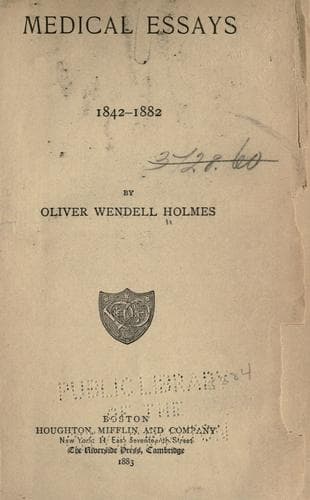
Education, Medical -- Massachusetts -- 19th century; Homeopathy; Libraries, Medical -- Massachusetts -- 19th century; Medicine
Let us turn to a branch of knowledge which deals with certainties up to
the limit of the senses, and is involved in no speculations beyond them.
In certain points of view, HUMAN ANATOMY may be considered an almost
exhausted science. From time to time some small organ which had escaped
earlier observers has been pointed out,--such parts as the tensor
tarsi, the otic ganglion, or the Pacinian bodies; but some of our best
anatomical works are those which have been classic for many generations.
The plates of the bones in Vesalius, three centuries old, are still
masterpieces of accuracy, as of art. The magnificent work of Albinus on
the muscles, published in 1747, is still supreme in its department,
as the constant references of the most thorough recent treatise on
the subject, that of Theile, sufficiently show. More has been done in
unravelling the mysteries of the fasciae, but there has been a tendency
to overdo this kind of material analysis. Alexander Thomson split them
up into cobwebs, as you may see in the plates to Velpeau's Surgical
Anatomy. I well remember how he used to shake his head over the coarse
work of Scarpa and Astley Cooper,--as if Denner, who painted the
separate hairs of the beard and pores of the skin in his portraits, had
spoken lightly of the pictures of Rubens and Vandyk.
Not only has little been added to the catalogue of parts, but some
things long known had become half-forgotten. Louis and others confounded
the solitary glands of the lower part of the small intestine with those
which “the great Brunner,” as Haller calls him, described in 1687 as
being found in the duodenum. The display of the fibrous structure of the
brain seemed a novelty as shown by Spurzheim. One is startled to find
the method anticipated by Raymond Vieussens nearly two centuries ago. I
can hardly think Gordon had ever looked at his figures, though he names
their author, when he wrote the captious and sneering article which
attracted so much attention in the pages of the “Edinburgh Review.”
Public-domain text, read in full here on John Shaqi.
Reviews
Reviews
No reviews yet
Be the first to share your thoughts on this work.
Elsewhere in the archive
Join the Discussion
Join the discussion
Sign in to leave a comment or review.
Sign InorCreate an account