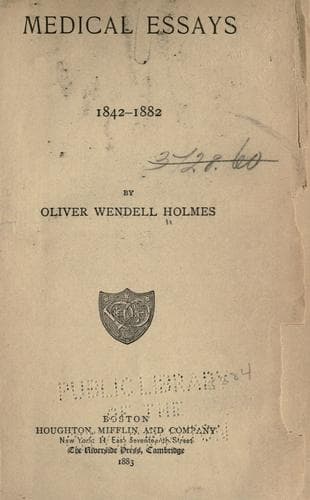
Education, Medical -- Massachusetts -- 19th century; Homeopathy; Libraries, Medical -- Massachusetts -- 19th century; Medicine
C. The white fibrous element, consisting of very delicate, tenacious
threads. This is the long staple textile substance of the body. It is to
the organism what cotton is pretended to be to our Southern States.
It pervades the whole animal fabric as areolar tissue, which is the
universal packing and wrapping material. It forms the ligaments which
bind the whole frame-work together. It furnishes the sinews, which are
the channels of power. It enfolds every muscle. It wraps the brain in
its hard, insensible folds, and the heart itself beats in a purse that
is made of it.
D. The yellow elastic, fibrous element, the caoutchouc of the animal
mechanism, which pulls things back into place, as the India-rubber band
shuts the door we have opened.
E. The striped muscular fibre,--the red flesh, which shortens itself in
obedience to the will, and thus produces all voluntary active motion.
F. The unstriped muscular fibre, more properly the fusiform-cell fibre,
which carries on the involuntary internal movements.
G. The nerve-cylinder, a glassy tube, with a pith of some firmness,
which conveys sensation to the brain and the principle which induces
motion from it.
H. The nerve-corpuscle, the centre of nervous power.
I. The mucous tissue, as Virchow calls it, common in embryonic
structures, seen in the vitreous humor of the adult.
To these add X, granules, of indeterminate shape and size, Y, for
inorganic matters, such as the salts of bone and teeth, and Z, to stand
as a symbol of the fluids, and you have the letters of what I have
ventured to call the alphabet of the body.
But just as in language certain diphthongs and syllables are frequently
recurring, so we have in the body certain secondary and tertiary
combinations, which we meet more frequently than the solitary elements
of which they are composed.
Public-domain text, read in full here on John Shaqi.
Reviews
Reviews
No reviews yet
Be the first to share your thoughts on this work.
Elsewhere in the archive
Join the Discussion
Join the discussion
Sign in to leave a comment or review.
Sign InorCreate an account