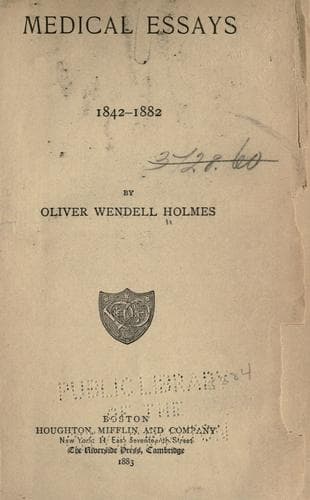
Education, Medical -- Massachusetts -- 19th century; Homeopathy; Libraries, Medical -- Massachusetts -- 19th century; Medicine
It would have been reward enough to learn the method Nature pursues
for its own sake. If the sovereign Artificer lets us into his own
laboratories and workshops, we need not ask more than the privilege
of looking on at his work. We do not know where we now stand in the
hierarchy of created intelligences. We were made a little lower than the
angels. I speak it not irreverently; as the lower animals surpass man
in some of their attributes, so it may be that not every angel's eye
can see as broadly and as deeply into the material works of God as
man himself, looking at the firmament through an equatorial of fifteen
inches' aperture, and searching into the tissues with a twelfth of an
inch objective.
But there are other positive gains of a more practical character. Thus
we are no longer permitted to place the seat of the living actions in
the extreme vessels, which are only the carriers from which each part
takes what it wants by the divine right of the omnipotent nucleated
cell. The organism has become, in the words already borrowed from
Virchow, “a sum of vital unities.” The strictum and laxum, the increased
and diminished action of the vessels, out of which medical theories
and methods of treatment have grown up, have yielded to the doctrine
of local cell-communities, belonging to this or that vascular district,
from which they help themselves, as contractors are wont to do from the
national treasury.
I cannot promise to do more than to select a few of the points of
contact between our ignorance and our knowledge which present particular
interest in the existing state of our physiological acquisitions.
Some of them involve the microscopic discoveries of which I have
been speaking, some belong to the domain of chemistry, and some have
relations with other departments of physical science.
If we should begin with the digestive function, we should find that the
long-agitated question of the nature of the acid of the gastric juice is
becoming settled in favor of the lactic. But the whole solvent agency of
the digestive fluid enters into the category of that exceptional mode of
action already familiar to us in chemistry as catalysis. It is therefore
doubly difficult of explanation; first, as being, like all reactions,
a fact not to be accounted for except by the imaginative appeal to
“affinity,” and secondly, as being one of those peculiar reactions
provoked by an element which stands outside and looks on without
compromising itself.
Public-domain text, read in full here on John Shaqi.
Reviews
Reviews
No reviews yet
Be the first to share your thoughts on this work.
Elsewhere in the archive
Join the Discussion
Join the discussion
Sign in to leave a comment or review.
Sign InorCreate an account