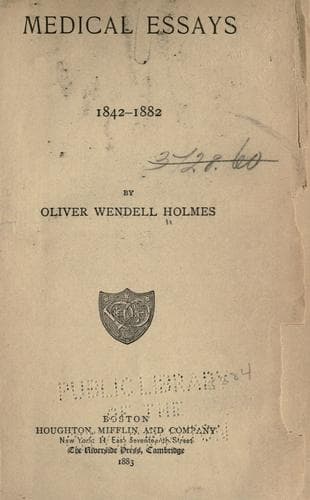
Education, Medical -- Massachusetts -- 19th century; Homeopathy; Libraries, Medical -- Massachusetts -- 19th century; Medicine
Strictly speaking, every poison consisting of assimilable elements may
be considered as unwholesome food. It is rejected by the stomach, or it
produces diarrhoea, or it causes vertigo or disturbance of the heart's
action, or some other symptom for which the subject of it would consult
the physician, if it came on from any other cause than taking it under
the name of medicine. Yet portions of this unwholesome food which
we call medicine, we have reason to believe, are assimilated; thus,
castor-oil appears to be partially digested by infants, so that they
require large doses to affect them medicinally. Even that deadliest of
poisons, hydrocyanic acid, is probably assimilated, and helps to make
living tissue, if it do not kill the patient, for the assimilable
elements which it contains, given in the separate forms of amygdalin and
emulsin, produce no disturbance, unless, as in Bernard's experiments,
they are suffered to meet in the digestive organs. A medicine consisting
of assimilable substances being then simply unwholesome food, we
understand what is meant by those cumulative effects of such remedies
often observed, as in the case of digitalis and strychnia. They are
precisely similar to the cumulative effects of a salt diet in producing
scurvy, or of spurred rye in producing dry gangrene. As the effects of
such substances are a violence to the organs, we should exercise the
same caution with regard to their use that we would exercise about
any other kind of poisonous food,--partridges at certain seasons, for
instance. Even where these poisonous kinds of food seem to be useful, we
should still regard them with great jealousy. Digitalis lowers the pulse
in febrile conditions. Veratrum viride does the same thing. How do we
know that a rapid pulse is not a normal adjustment of nature to the
condition it accompanies? Digitalis has gone out of favor; how sure are
we that Veratrum viride will not be found to do more harm than good in
a case of internal inflammation, taking the whole course of the disease
into consideration? Think of the change of opinion with regard to the
use of opium in delirium tremens (which you remember is sometimes called
delirium vigilans), where it seemed so obviously indicated, since the
publication of Dr. Ware's admirable essay. I respect the evidence of
my contemporaries, but I cannot forget the sayings of the Father of
medicine,--Ars longa, judicium difficile.
I am not presuming to express an opinion concerning Veratrum viride,
which was little heard of when I was still practising medicine. I am
only appealing to that higher court of experience which sits in judgment
on all decisions of the lower medical tribunals, and which requires more
than one generation for its final verdict.
Public-domain text, read in full here on John Shaqi.
Reviews
Reviews
No reviews yet
Be the first to share your thoughts on this work.
Elsewhere in the archive
Join the Discussion
Join the discussion
Sign in to leave a comment or review.
Sign InorCreate an account