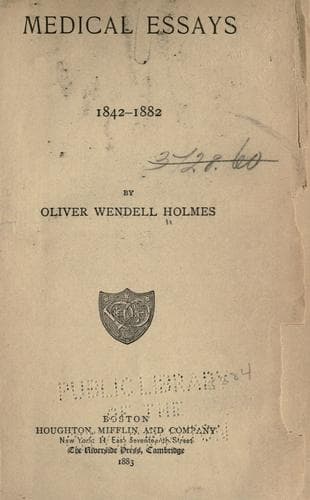
Education, Medical -- Massachusetts -- 19th century; Homeopathy; Libraries, Medical -- Massachusetts -- 19th century; Medicine
Let me here mention a fact or two which may be of use to some of you who
mean to enter the public service. You will, as it seems, have gun-shot
wounds almost exclusively to deal with. Three different surgeons, the
one just mentioned and two who saw the wounded of Big Bethel, assured me
that they found no sabre-cuts or bayonet wounds. It is the rifle-bullet
from a safe distance which pierces the breasts of our soldiers, and not
the gallant charge of broad platoons and sweeping squadrons, such as
we have been in the habit of considering the chosen mode of warfare
of ancient and modern chivalry. [Sir Charles James Napier had the same
experience in Virginia in 1813. “Potomac. We have nasty sort of fighting
here, amongst creeks and bushes, and lose men without show.” “Yankee
never shows himself, he keeps in the thickest wood, fires and runs
off.”--“These five thousand in the open field might be attacked,
but behind works it would be throwing away lives.” He calls it “an
inglorious warfare,”--says one of the leaders is “a little deficient in
gumption,--but--still my opinion is, that if we tuck up our sleeves and
lay our ears back we might thrash them; that is, if we caught them out
of their trees, so as to slap at them with the bayonet.”--Life, etc.
vol. i. p. 218 et seq.]
Another fact parallels the story of the old campaigner, and may teach
some of you caution in selecting your assistants. A chaplain told it
to two of our officers personally known to myself. He overheard the
examination of a man who wished to drive one of the “avalanche” wagons,
as they call them. The man was asked if he knew how to deal with wounded
men. “Oh yes,” he answered; “if they're hit here,” pointing to the
abdomen, “knock 'em on the head,--they can't get well.”
In art and outside of it you will meet the same barbarisms that Ambroise
Pare met with,--for men differ less from century to century than we are
apt to suppose; you will encounter the same opposition, if you attack
any prevailing opinion, that Sydenham complained of. So far as possible,
let not such experiences breed in you a contempt for those who are the
subjects of folly or prejudice, or foster any love of dispute for its
own sake. Should you become authors, express your opinions freely;
defend them rarely. It is not often that an opinion is worth expressing,
which cannot take care of itself. Opposition is the best mordant to fix
the color of your thought in the general belief.
Public-domain text, read in full here on John Shaqi.
Reviews
Reviews
No reviews yet
Be the first to share your thoughts on this work.
Elsewhere in the archive
Join the Discussion
Join the discussion
Sign in to leave a comment or review.
Sign InorCreate an account