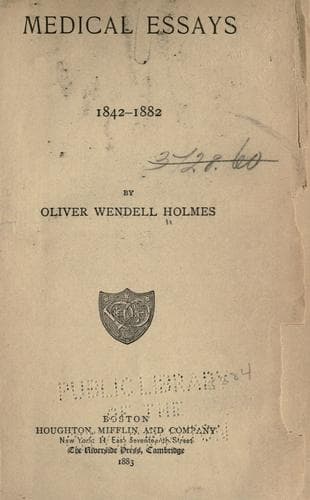
Education, Medical -- Massachusetts -- 19th century; Homeopathy; Libraries, Medical -- Massachusetts -- 19th century; Medicine
Since the time of the Apostle Eliot the Lord has stirred up the hearts
of our people to the building of many Schools and Colleges where
medicine is taught in all its branches. Mr. Giles Firmin's “Anatomy” may
be considered the first ancestor of a long line of skeletons which have
been dangling and rattling in our lecture-rooms for more than a century.
Teaching in New England in 1647 was a grave but simple matter. A single
person, combining in many cases, as in that of Mr. Giles Firmin,
the offices of physician and preacher, taught what he knew to a few
disciples whom he gathered about him. Of the making of that “Anatomy” on
which my first predecessor in the branch I teach “did read very well”
we can know nothing. The body of some poor wretch who had swung upon the
gallows, was probably conveyed by night to some lonely dwelling at the
outskirts of the village, and there by the light of flaring torches
hastily dissected by hands that trembled over the unwonted task.
And ever and anon the master turned to his book, as he laid bare the
mysteries of the hidden organs; to his precious Vesalius, it might be,
or his figures repeated in the multifarious volume of Ambroise Pare; to
the Aldine octavo in which Fallopius recorded his fresh observations; or
that giant folio of Spigelius just issued from the press of Amsterdam,
in which lovely ladies display their viscera with a coquettish grace
implying that it is rather a pleasure than otherwise to show the
lace-like omentum, and hold up their appendices epiploicae as if they
were saying “these are our jewels.”
His teaching of medicine was no doubt chiefly clinical, and received
with the same kind of faith as that which accepted his words from the
pulpit. His notions of disease were based on what he had observed, seen
always in the light of the traditional doctrines in which he was bred.
His discourse savored of the weighty doctrines of Hippocrates, diluted
by the subtle speculations of Galen, reinforced by the curious comments
of the Arabian schoolmen as they were conveyed in the mellifluous
language of Fernelius, blended, it may be, with something of the lofty
mysticism of Van Helmont, and perhaps stealing a flavor of that earlier
form of Homoeopathy which had lately come to light in Sir Kenelm Digby's
“Discourse concerning the Cure of Wounds by the Sympathetic Powder.”
Public-domain text, read in full here on John Shaqi.
Reviews
Reviews
No reviews yet
Be the first to share your thoughts on this work.
Elsewhere in the archive
Join the Discussion
Join the discussion
Sign in to leave a comment or review.
Sign InorCreate an account