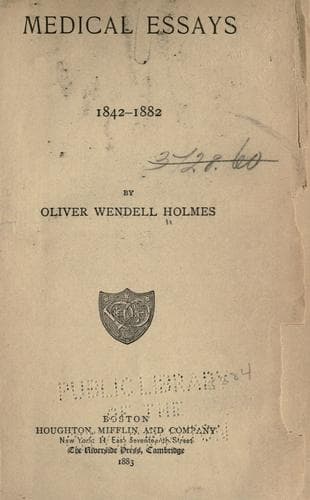
Education, Medical -- Massachusetts -- 19th century; Homeopathy; Libraries, Medical -- Massachusetts -- 19th century; Medicine
“Yea, Luke, I do think she shall be well, and mayhap speedily. But it is
not here with us she shall be well. For that redness of the cheek is
but the sign of the fever which, after the Grecians, we do call the
hectical; and that shining of the eyes is but a sickly glazing, and they
which do every day get better and likewise thinner and weaker shall find
that way leadeth to the church-yard gate. This is the malady which the
ancients did call tubes, or the wasting disease, and some do name the
consumption. A disease whereof most that fall ailing do perish. This
Margaret is not long for earth--but she knoweth it not, and still
hopeth.”
“Why, then, Master, didst thou give her of thy medicine, seeing that her
ail is unto death?”
“Thou shalt learn, boy, that they which are sick must have somewhat
wherewith to busy their thoughts. There be some who do give these tabid
or consumptives a certain posset made with lime-water and anise and
liquorice and raisins of the sun, and there be other some who do give
the juice of craw-fishes boiled in barley-water with chicken-broth,
but these be toys, as I do think, and ye shall find as good virtue, nay
better, in this syrup of the simple called Maidenhair.”
Something after this manner might Master Giles Firmin have delivered his
clinical instructions. Somewhat in this way, a century and a half later,
another New England physician, Dr. Edward Augustus Holyoke, taught a
young man who came to study with him, a very diligent and intelligent
youth, James Jackson by name, the same whose portrait in his advanced
years hangs upon this wall, long the honored Professor of Theory and
Practice in this Institution, of whom I shall say something in this
Lecture. Our venerated Teacher studied assiduously afterwards in the
great London Hospitals, but I think he used to quote his “old Master”
ten times where he quoted Mr. Cline or Dr. Woodville once.
When I compare this direct transfer of the practical experience of a
wise man into the mind of a student,--every fact one that he can use
in the battle of life and death,--with the far off, unserviceable
“scientific” truths that I and some others are in the habit of teaching,
I cannot help asking myself whether, if we concede that our forefathers
taught too little, there is not--a possibility that we may sometimes
attempt to teach too much. I almost blush when I think of myself as
describing the eight several facets on two slender processes of the
palate bone, or the seven little twigs that branch off from the minute
tympanic nerve, and I wonder whether my excellent colleague feels in the
same way when he pictures himself as giving the constitution of
neurin, which as he and I know very well is that of the hydrate of
trimethyle-oxethyle-ammonium, or the formula for the production of
alloxan, which, though none but the Professors and older students can
be expected to remember it, is C10 H4 N4 O6+ 2HO, NO5=C8 H4 N2
O10+2CO2+N2+NH4 O, NO5.
Public-domain text, read in full here on John Shaqi.
Reviews
Reviews
No reviews yet
Be the first to share your thoughts on this work.
Elsewhere in the archive
Join the Discussion
Join the discussion
Sign in to leave a comment or review.
Sign InorCreate an account